
Following Closure of Suwung Landfill to Organic Waste, Officials Inspect Every Truck Bringing Waste to Suwung Landfill
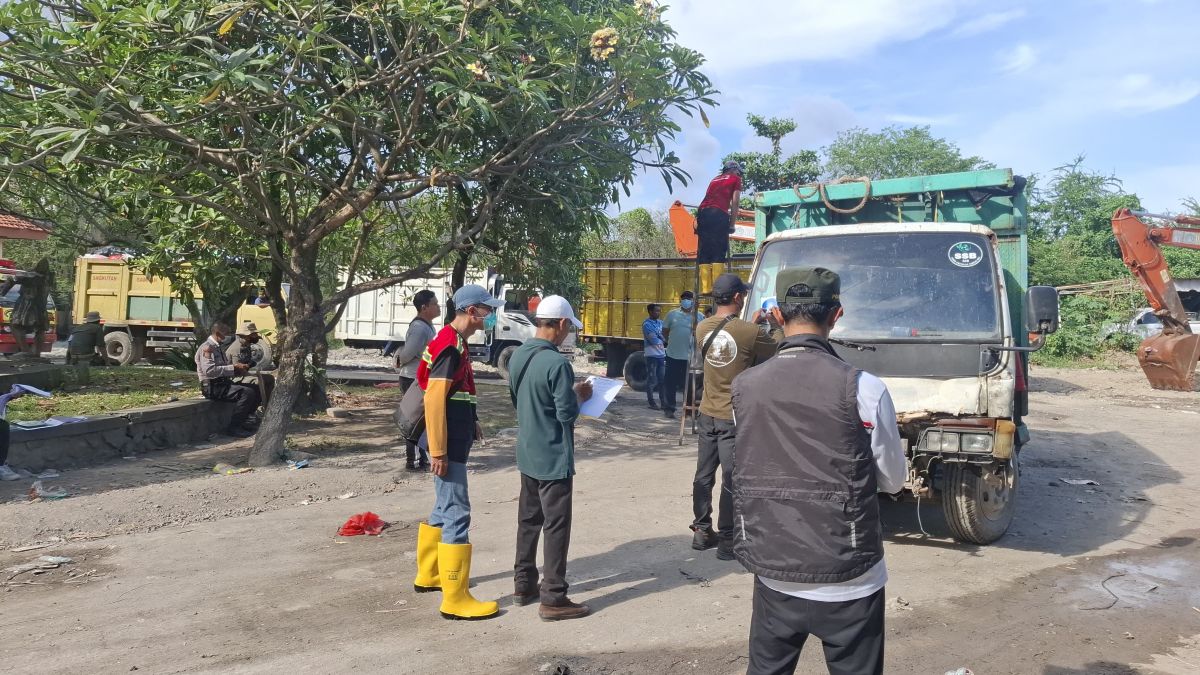
The Bali Provincial Government has committed to closing the Suwung Landfill to organic waste since 1 April 2026. This means that since 1 April 2026, only non-organic waste or residue can enter the Suwung Landfill. The Suwung Landfill will be completely closed in August 2026. Entering the third day after the closure of the Suwung Landfill to organic waste, queues of rubbish trucks were still visible in the South Denpasar area on Friday afternoon to evening (3/4/2026). Several rubbish trucks apparently still attempted to enter the Suwung Landfill area carrying organic waste. However, officials conducted strict checks on every load brought in.
Dozens of trucks were seen queuing and inspected one by one by officials from the Technical Implementation Unit (UPT) for Waste Management of the Forestry and Environmental Living Department (DKLH) of Bali Province. Every truck was strictly inspected. If they stubbornly tried to enter, they would not be given a certificate by the officials, and the relevant fleet would be prohibited from entering the Suwung Landfill again.
The Head of the UPT for Waste Management of DKLH Bali, I Putu Agus Juliartawan, emphasised that his side would not tolerate organic waste still being brought to the landfill. Officials would inspect every truck entering, and if even a small amount of organic waste was found, it would be ordered to turn back. “If organic waste is found, we immediately tell them to turn back,” he asserted at the Suwung Landfill on Friday (3/4/2026).
This firm policy has drawn complaints from several rubbish truck drivers. One of them, Ferdy, a driver from the Banjar Brawa community-managed waste forum in Canggu, Badung, claimed that all the waste he carried had undergone sorting before being transported to the Suwung Landfill. However, because traces of organic waste such as orange peels and bones were still found, his truck was still asked to return. “Even though it has been sorted, but there are still a few orange peels and bones, they still tell us to go back,” he said.
According to Juliartawan, there is no other solution for trucks that do not fully comply with the regulations except to return to the waste source for re-sorting. He said this inspection process would continue non-stop with a shift system for officials every two hours.
It was observed that dozens of DKLH officials have been on guard since morning, assisted by joint personnel from the police, TNI, and Satpol PP to keep the situation conducive. This step is taken to ensure that the organic waste ban policy runs effectively in the field.
Meanwhile, the Head of the Environmental Living and Forestry Department (LHK) of Bali, I Made Dwi Arbani, who was met at the location, declined to provide comment.
His face appeared tired when asked whether the waste transporting drivers already understood that waste entering the landfill must go through a sorting process; according to him, this should already be known by the drivers. “They should already know. Socialisation has been done, announcements have been made, mainstream media coverage has been done,” he said briefly while crossing his arms, indicating reluctance to explain in more detail.
Previously, the Bali Provincial Government through Bali Governor Wayan Koster ensured that the closure of the Suwung Landfill would proceed as scheduled. The closure is carried out in stages, starting with the cessation of acceptance of organic waste since 31 March 2026. Since 1 April 2026, the landfill only accepts residual waste. The government also provides a transition period until 31 August 2026 before the total closure is enforced. This policy is part of the transformation of Bali’s waste management system, which prioritises processing from the source.
As a long-term solution, the Bali Provincial Government is preparing the construction of a Waste Processing to Electricity Energy facility (PSEL). This project will be built on a 6-hectare plot of land owned by PT Pelindo, with a processing capacity of up to 1,200 tons of waste per day from the Denpasar and Badung areas.
Construction is scheduled to begin in June 2026 and is targeted to be completed by the end of 2027. The facility is expected to start operating in early 2028 with the operator Zhejiang Weiming Environment Protection Co., Ltd.
In addition to DKLH, waste transportation services such as BUMDes Dalung have also conveyed socialisation regarding the waste sorting policy.
Hundreds of rubbish trucks queued in a long line at the entrance to the Suwung Landfill. Observations at the location showed a long queue almost 2 kilometres from the entrance gate to the Suwung Landfill.
Bali’s waste problem has reached a high level of vulnerability and can no longer be handled with the old pattern that relies on landfills.
Governor of Bali Wayan Koster’s policy to close the Suwung Landfill to organic waste has sparked controversy.