
Flyover, an Urgent Solution to Avoid Train Accidents
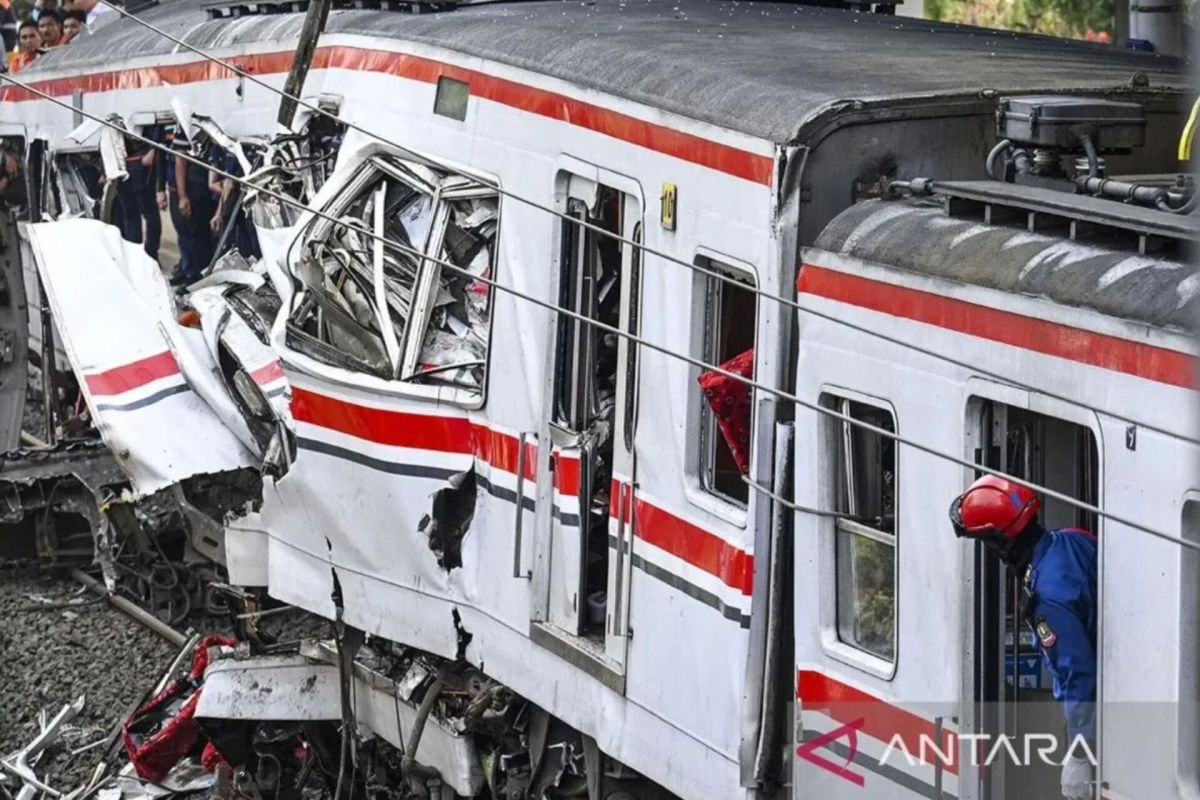
President Prabowo Subianto himself has acted swiftly, one of which is by promising to build a flyover. Now, what is needed is swift action from the apparatus under him to realise and oversee this urgent initiative.
Jakarta (ANTARA) - There has been sharp criticism directed at the train driver, taxi driver, and even the Director of PT Kereta Api Indonesia (KAI), following the train accident in Bekasi on 27 April 2026, which killed at least 16 people.
The train accident in East Bekasi itself is similar to several previous train accidents, namely occurring around level crossings.
Demanding accountability from someone is not wrong and is commonplace, as long as it targets the right person. But forgetting the root cause of accidents that often recur is even more wrong.
The main root of the problem is the condition around the level crossings, specifically at-grade crossings. It is at these points that the greatest energy of this nation must be directed.
Many train accidents occur or at least are related to the situation at level crossings, which often start from poor driving habits that frequently break through what should not be broken, including crossing gates when a train is about to pass. Even pedestrians often recklessly break through when a train is approaching.
Look at the train accident that occurred in Pondok Betung, Bintaro, South Jakarta, on 9 December 2013.
This accident was initiated by vehicles breaking through the crossing gate, then stopping on the tracks. At the same time, the train was speeding along that track and required a long distance to brake, making the collision unavoidable.
Although the death toll from this accident was not as high as in previous incidents, including compared to the accident in East Bekasi some time ago, PT KAI Commuter Jabodetabek immediately carried out several improvements. One of them was adding emergency instruction signs on the KRL, considering that during the incident many passengers were confused about opening the emergency doors.
However, the drastic step taken at that time was to build a flyover.
Although it was only realised four years later, the Pondok Betung flyover effectively closed off opportunities for accidents, while also improving train journey safety, just like the flyovers on this route, including the Permata Hijau flyover.
Building a flyover is indeed expensive and time-consuming, but this is a very effective step in improving train journey safety and preventing the loss of human lives.
This option becomes increasingly important because in this country, the habit of drivers and pedestrians to break through train crossings is still difficult to stop.
Many people still recklessly break through the crossing gates, even though a few minutes before the barriers are fully closed, warning signals can already be heard indicating that a train will pass. Even the sound can often be heard up to a radius of about one kilometre.
This bad habit occurs everywhere, which even the crossing guards find difficult to remind people about.
In a country where drivers often speed up when traffic lights change from green to yellow, even running red lights or driving against the flow, it is difficult if preventing train accidents only relies on public awareness and the threat of sanctions.
Therefore, steps are needed that go beyond mere appeals and law enforcement.