
Flood Victims Said to Face Eviction from Bireuen Regent's Office; GeRAK Bireuen: Officials Lack Empathy
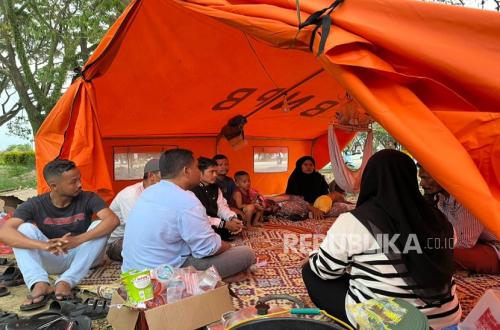
Bireuen — An official from the Regional Secretary’s Office of Bireuen Regency reportedly stated that flood evacuees could be forcibly removed from the grounds of the Regent’s Office. This statement has drawn condemnation from the Anti-Corruption Movement (GeRAK) Bireuen. According to GeRAK Bireuen’s coordinator, Murni M. Nasir, the statement was viewed as lacking empathy, insensitive to the suffering of victims, and potentially exacerbating an unresolved humanitarian situation.
When contacted by Republika, Murni stated that a public official should present fair and humanitarian solutions for disaster victims, rather than issuing statements that could isolate victims fighting for their rights. She emphasised that flood victims are not public order violators who can be treated like street vendors.
“They are residents who have lost their homes, lost their possessions, and are still surviving in tents to this day. In such circumstances, the state has a duty to be present to protect and restore their lives,” Murni said on Saturday (14 March 2026).
According to her, the victims’ decision to pitch tents at the Regent’s Office grounds is not a form of provocation, but rather an expression of desperation after months of waiting for certainty from the government regarding the construction of housing for flood and landslide victims that occurred on 26 November 2025. “They came to the regent’s office not to cause trouble. They came because they felt unheard in their own villages. This is a cry from residents who have lost their homes and whose futures remain uncertain,” she said.
GeRAK Bireuen believes that the government’s focus should not be on the presence of tents at the regent’s office grounds, but rather on ensuring the rights of disaster victims are fulfilled as mandated by disaster management regulations, including the provision of Temporary Housing (Huntara) and Permanent Housing (Huntap) for those who have lost their homes. “If the government is serious about resolving this issue, what needs to be built is a solution, not an eviction narrative. Build temporary or permanent housing for victims, do not treat them as if they are the problem,” Murni said.
GeRAK Bireuen also raised concerns about reports of the government’s offer to place some evacuees in rental homes. According to Murni, this policy could create injustice if offered only to victims currently surviving in tents at the Regent’s Office.
“If rental housing is only offered to those brave enough to pitch tents at the regent’s office, it demonstrates an unfair approach to disaster victim assistance. There are still many other flood victims in various villages across Bireuen who continue to live in tents but are not receiving the same attention,” she said.
Murni believes that disaster management should not be conducted partially or reactively simply because of pressure or public scrutiny. “There should not be an impression that assistance only arrives when victims are forced to come to the regent’s office. The government must view this issue holistically and ensure all victims receive equal rights,” she said.
For this reason, she reminded officials that leadership in a disaster situation demands commitment to humanity, not merely protecting bureaucratic image. “Leaders must not be unjust to their own people. Disaster victims have already lost their homes and possessions; they must not also lose their rights as citizens,” she emphasised.
GeRAK Bireuen assured that civil society will continue to advocate for the victims’ cause until there is a concrete solution from the government. “If there are attempts to suppress victims or treat them unfairly, we from the civil society movement are ready to stand with them. Disaster victims must not become victims of policy,” Murni concluded.