
Flood Mud Still Covers Roads in Pulau Tondan Area, West Jakarta
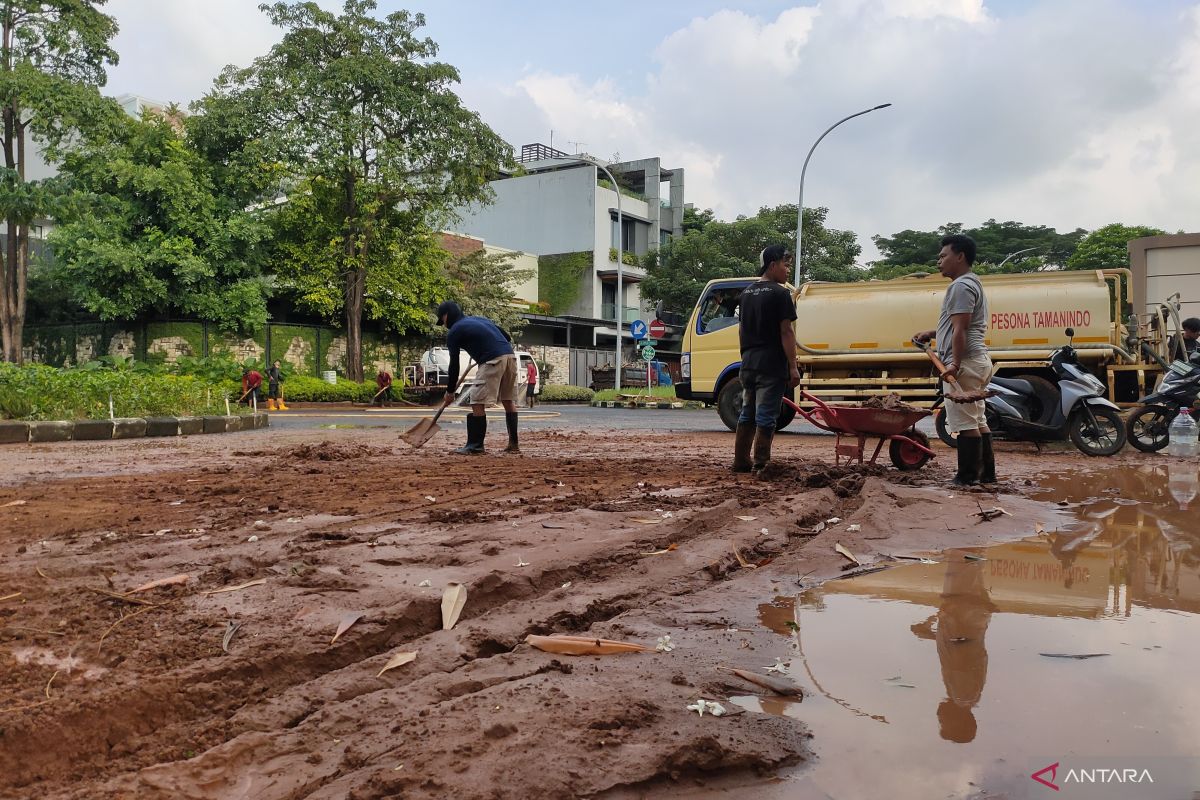
Jakarta — Mud from floodwaters continues to cover roads in the Pulau Tondan area, Taman Permata Buana residential complex, Kembangan, West Jakarta, as of Monday evening.
On-site observation at 4:30 p.m. local time revealed residents cleaning mud from the residential area. Several water tanker trucks were deployed to clear mud from the roads.
Along the riverbank, mud had accumulated in marsh-like formations just outside newly installed sheet piling barriers.
The embankment, which remains under construction, proved too short when water levels in the river rose significantly following rain beginning Saturday evening.
According to Supriadi, the residential complex’s security officer, water in the river exceeded the newly installed embankment during the incident, causing floodwater mixed with mud to spill into the residential streets.
He stated that before the embankment construction project, the residential area had never experienced flooding.
“The flooding occurred on Sunday evening. The river water was so high that it flowed over the embankment and entered the residents’ homes,” Supriadi said.
He clarified that the embankment at the West Jakarta Water Resources Office project location did not collapse, but rather experienced overflow because the sheet piling and embankment construction remains incomplete.
“If it had collapsed, the sheet piling would have collapsed, but that didn’t happen. The water was simply too high to be contained by the embankment. Moreover, the embankment is still under construction,” he explained.
Supriadi indicated that flooding affected two community associations—RW 11 and RW 9 of Taman Permata Buana residential complex.
Water levels during the incident are estimated to have reached approximately 50 to 60 centimetres.
Nevertheless, Supriadi confirmed that water did not enter residents’ homes.
“The water only reached the courtyards or yards of homes, not inside the houses,” he stated.
He added that the remaining mud on the roads originated from soil from the embankment construction project that was carried by the current during flooding.
“The mud came from soil displaced by the water current, which was quite strong,” Supriadi explained.
He noted that water levels began receding from Monday morning around 4:00 a.m. after response efforts were implemented at the location.
“From dawn, the water had already started to recede. The project team and the water resources team immediately took action to prevent further water overflow into residents’ homes,” he said.