
Five Myths of Lunar Eclipse from Various Cultures and the Science Behind Them
Lunar eclipses have always captivated the eyes of those who observe them. However, long before advanced telescopes were invented, this celestial phenomenon was often regarded as a mystical and thrilling event. From dragons swallowing the moon to symbols of peace, every civilisation has had a unique way of explaining why Earth’s natural satellite suddenly dims or changes colour to reddish hues. Let us explore more deeply five of the most popular lunar eclipse myths in the world and compare them with the modern scientific explanations behind them.
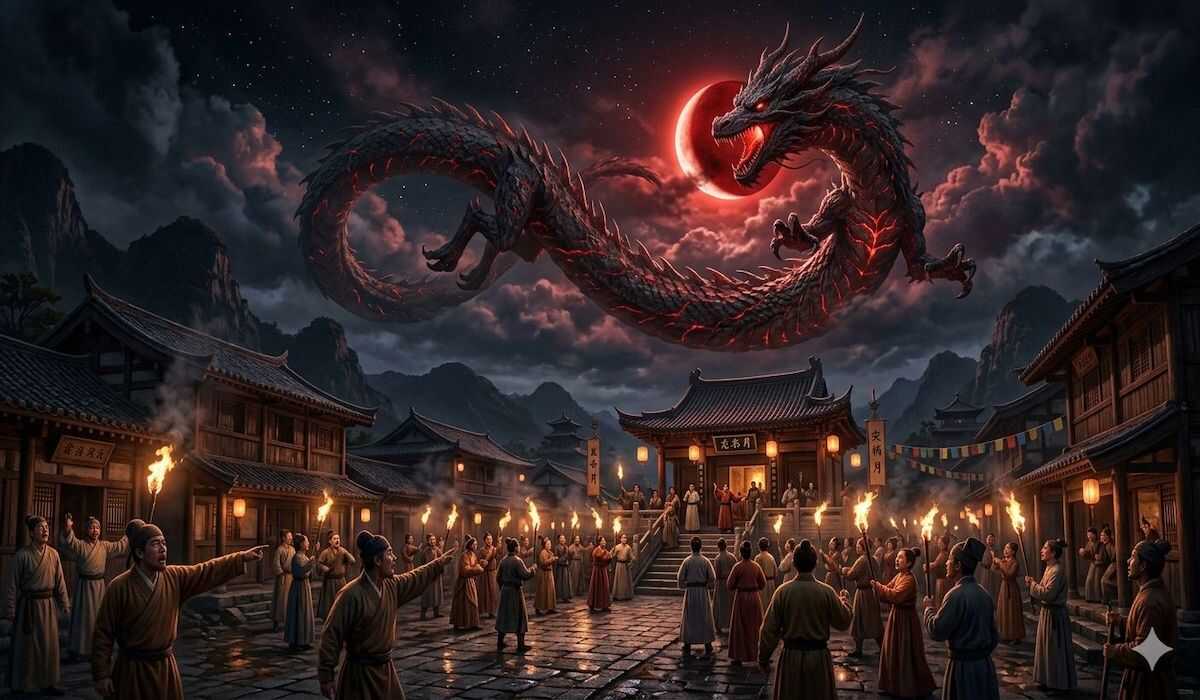
In the records of ancient China, lunar eclipses were not viewed as orbital positions of celestial bodies, but rather as an attack. The people believed that a sky dragon was attempting to devour the moon. To save the moon, residents would gather in the streets whilst striking drums, pans, and any musical instruments that could produce loud noise. The goal was singular: to frighten the dragon into regurgitating the moon.
Scientific Fact: Astronomically, a lunar eclipse occurs because of a Syzygy configuration, a condition in which the Sun, Earth, and Moon are in a straight line. Sunlight is blocked by Earth’s body, so Earth’s shadow falls upon the Moon’s surface.
In India, Hindu mythology recounts the story of Rahu, a demon who drank the elixir of immortality (Amrita). The Sun and Moon reported Rahu’s actions to the god Vishnu, who then beheaded Rahu. However, because Rahu had already drunk the immortal potion, his head remained alive and pursued the Sun and Moon to seek revenge.
Scientific Fact: This phenomenon is a highly predictable event. Lunar eclipses only occur during the full moon phase when the moon crosses the nodal point of its orbit that intersects with Earth’s ecliptic plane.
For the Inca civilisation in South America, a lunar eclipse was a frightening moment. They believed a giant jaguar was attacking and eating the moon. Their greatest fear was that after the jaguar finished devouring the moon, the ferocious animal would descend to Earth to prey upon humans.
Scientific Fact: The red colour often seen during a total lunar eclipse (Blood Moon) appears because Earth’s atmosphere refracts sunlight and disperses the red spectrum of colour onto the moon’s surface, a phenomenon known as Rayleigh Scattering.
Unlike other myths with a tone of fear, the Batammaliba people of Togo and Benin held a wiser perspective. For them, a lunar eclipse was a symbol of conflict between the Sun and Moon. The community viewed this as a warning to humans to resolve their own disputes.
Scientific Fact: Lunar eclipses do indeed involve an interaction between the Sun and Moon, but not in the form of conflict. This is a harmonious dance of gravity that occurs on average two to five times per year.
One of the most enduring myths is the belief that a lunar eclipse is a harbinger of a great disaster to come. This is often linked to the appearance of a dark red moon, considered a symbol of bloodshed.
Scientific Fact: Based on data from the International Astronomical Union (IAU), there is no statistical correlation between the occurrence of lunar eclipses and natural disasters. Eclipses are routine cycles governed by the laws of physics.
Although modern science has provided definitive answers, the myths about lunar eclipses offer us valuable insight into the history of human culture. Appreciating these myths means appreciating how ancient humans tried to understand the universe before modern technology existed.