
Five Mosques Built by Waskita Karya Ready for Eid al-Fitr Prayers
In preparation for Eid al-Fitr 1447 Hijriah, mosques throughout Indonesia are gearing up to hold congregational Eid prayers. Five major mosques constructed by PT Waskita Karya (Persero) Tbk (WSKT) offer viable worship options for the public.
Waskita Karya’s Corporate Secretary, Ermy Puspa Yunita, stated that the company has built and renovated the Istiqlal Mosque in Jakarta, Baiturrahman in Aceh, Sheikh Zayed in Solo, Baiturrahman in Semarang, and Al-Akbar in Surabaya. These five mosques can accommodate up to 200,000 worshippers.
“The construction of these mosques represents the company’s contribution to providing facilities that support Muslim worship. As a state-owned construction firm with over 65 years of experience, we want worshippers to pray with devotion, safety, and comfort,” Ermy said in an official statement on Friday (20/3/2026).
In executing the projects, Waskita Karya not only focused on building quality but also considered the history or background of each mosque’s establishment. This approach ensures alignment with the original structure without significant alterations.
“In this way, the historical value remains evident in the mosque buildings. For instance, the Baiturrahman Mosque in Aceh, one of the oldest dating back to 1612, was designed to resemble the Nabawi Mosque in Madinah, Saudi Arabia,” she explained.
Ermy continued that this mosque, with a capacity of over 24,000 worshippers, features 12 giant umbrellas and date palm trees around the courtyard, enhancing its similarity to the Nabawi Mosque. Renovated by Waskita Karya in 2015, it remains a key religious and cultural tourism destination in the City of the Veranda of Mecca.
Historical value is also evident in the Great Baiturrahman Mosque in Semarang, first inaugurated in December 1974. During the renovation of this central city structure, Waskita Karya preserved the form without significant changes, making it more majestic and modern.
“The mosque’s design was retained with traditional Javanese architecture adopting a limasan structure. However, we added elements like a water pond to create a cooler atmosphere around the mosque,” Ermy clarified.
For context, Waskita Karya completed the project in just 11 months by implementing the Building Automation System (BAS). This system integrates air conditioning, special lighting, and Mechanical, Electrical, Plumbing (MEP) control equipment.
“Waskita is proud to be involved in building one of the icons and a cultural heritage area in Central Java’s capital. We hope worshippers will have the best experience praying at this mosque located in Semarang’s town square,” she added.
Next is the Sheikh Zayed Mosque in Solo, a gift from the United Arab Emirates (UAE) to Indonesia, symbolising friendship between the two nations.
“The mosque, built by Waskita in 2021, was completed on time. The company also incorporated green building innovations and modern technological facilities,” she noted.
Ermy mentioned that the Sheikh Zayed Mosque in Solo mirrors the Sheikh Zayed Mosque in Abu Dhabi, UAE. However, the structure, which can hold up to 15,000 worshippers, includes distinctive Solo touches such as kawung batik motifs on the floors and pillars.
Furthermore, in 2022, Waskita Karya renovated the National Al-Akbar Mosque in Surabaya. Beyond enhancing the exterior facade, the company ensured structural reliability and comfort for visitors and worshippers from various cities.
As Indonesia’s second-largest mosque, it can accommodate up to 36,000 or even 45,000 worshippers. It is no surprise that every Eid, crowds flock there for Eid al-Fitr prayers.
“The National Al-Akbar Mosque in Surabaya stands as an architectural masterpiece blending modern aesthetics with Islamic philosophy. Every corner is designed to create harmony, making it a religious icon in East Java,” Ermy explained.
In addition to its blue and green domes, the mosque’s hallmark is the main prayer hall designed without central pillars, ensuring unobstructed views to the mihrab and neat prayer lines.
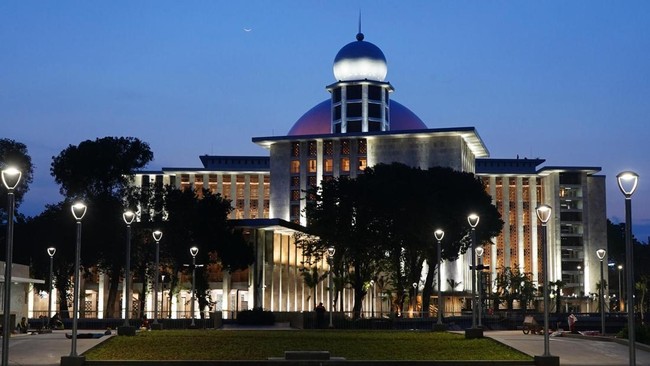
Ermy added that Waskita Karya is also proud to have renovated Indonesia’s grandest mosque, Istiqlal. Completed in 2021, it now features contemporary technology as part of green building innovations.
Besides internal lighting, the exterior lighting was improved, including illumination of the Istiqlal Mosque’s dome, making the 120,000-capacity mosque shine at night.
Waskita Karya also constructed the Silaturahim Tunnel connecting the Istiqlal Mosque to the Cathedral Church. In 2024, the head of the Catholic Church and Vatican leader, Pope Francis, visited the tunnel, calling it a symbol of interfaith brotherhood.
“The five mosques built by Waskita symbolise Islamic civilisation in various regions. We hope that this year’s Eid al-Fitr celebrations allow the public to pray with their families in reverence and joy,” she concluded.