
First Wave of Junior Secondary Academic Ability Test Runs Smoothly, System and Participation Under Control
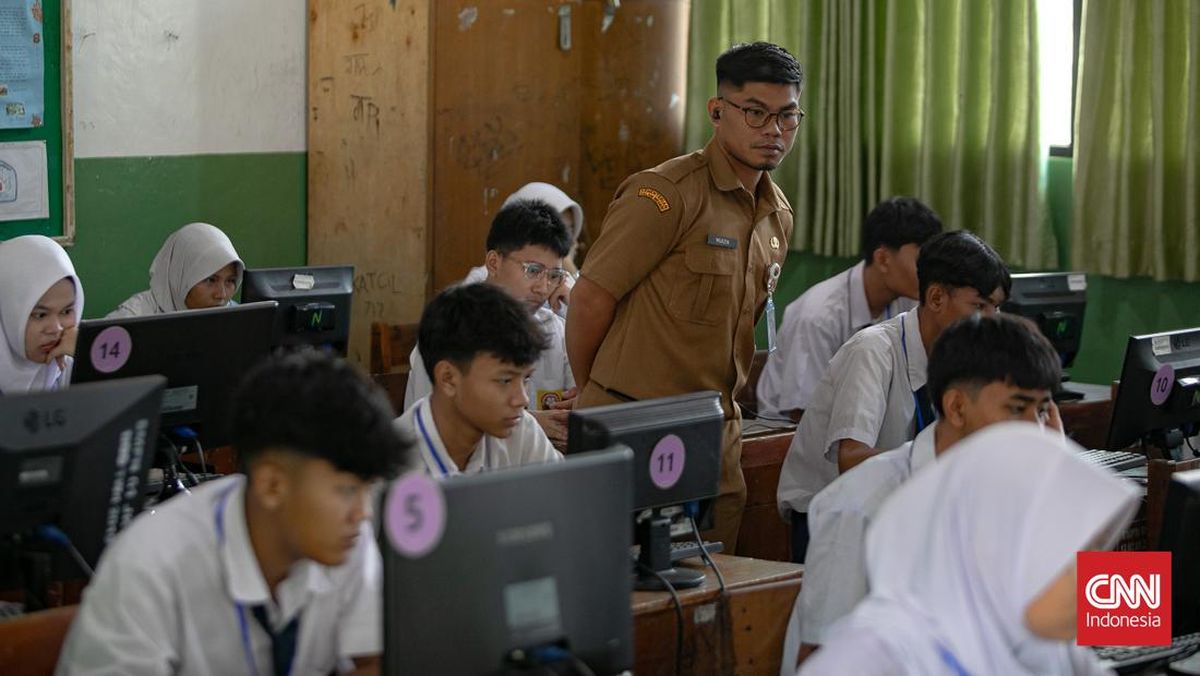
The implementation of the Academic Ability Test (TKA) for junior secondary level in the first wave, which took place from 6 to 7 April 2026, ran well throughout Indonesia.
Based on monitoring from the Central Command Post (Command Center) for TKA, the central system and infrastructure demonstrated good performance, with traffic levels still within the capacity limits that can be handled.
“Overall, for the first and second days of TKA, the system ran very stably and under control. Participation was very high, with strong support from other stakeholders, and the control mechanisms we implemented also ran effectively,” stated the Head of the Basic and Secondary Education Policy Agency (BKPDM), Toni Toharudin, in an official statement from the Ministry of Basic and Secondary Education on Tuesday (7/4).
In the first wave, a total of 1,935,778 participants took the TKA, consisting of 1,777,571 participants in online mode and 158,207 in semi-online mode. These participants came from 33,349 online mode implementing schools and 2,451 semi-online mode implementing schools, reflecting the involvement of educational units with varying levels of readiness.
The TKA implementation was also supported by 24,195 supervisors, along with 2,345 supervisors from provincial Education Offices and Regional Offices of the Ministry of Religious Affairs, as well as 42,852 online mode proctors and 3,188 semi-online mode proctors who ensured the smooth running of the assessment in each educational unit.
To maintain integrity, the TKA used a region-based question scheme with far greater variation compared to centralised questions, thereby minimising the potential for leaks and increasing the reliability of the assessment results.
“The involvement of various elements is a key factor in ensuring that the TKA implementation runs orderly, maintains its integrity, and adheres to the established standards,” he added.
The TKA for junior secondary level will be conducted from 6 to 16 April 2026, divided into four waves for formal educational units and one wave for equivalence education. “Of course, the approach we are taking ensures the same implementation standards across all regions of Indonesia, while also providing considerable flexibility for preparation by educational units through this wave system,” Toni added.
In its execution, the TKA is designed to run for two days per wave. On the first day, participants will undergo 10 minutes of practice, a 75-minute Mathematics and Numeracy test, and a 20-minute character survey. Then on the second day, participants will complete 10 minutes of practice, a 75-minute Indonesian Language and Literacy test, and a 20-minute learning environment survey.
To support the smooth implementation, the Ministry of Basic and Secondary Education also operates a central monitoring post (command centre) and regional support posts. These posts function to provide rapid and coordinated technical and non-technical support to educational units and students.
Toni also emphasised that the Ministry of Basic and Secondary Education will continue monitoring and improvements during the TKA implementation. “We are very optimistic about the synergy of all parties. This year’s Academic Ability Test will be a very important instrument in building a better education system in line with the policy direction of Quality Education for All,” he concluded.