
First Sighting of "Moth Star": Astronomers Discover Protective Shield Similar to the Sun on Alien Star
Our Sun is known to orbit the centre of the Milky Way galaxy within a giant protective bubble called the heliosphere. Now, for the first time, astronomers have successfully confirmed the existence of a similar structure around an alien star, an achievement that unveils the past of our Solar System.
The heliosphere is created by solar wind, a continuous stream of charged particles emanating from the Sun. This bubble functions as a magnetic shield that protects planets from deadly interstellar cosmic radiation. The outer boundary of the heliosphere marks the point where interstellar space begins.
A similar phenomenon has now been discovered around a star named HD 61005. Because the structure surrounds another star, scientists call it an “astrosphere”. This discovery is particularly remarkable because HD 61005 is only about 100 million years old, far younger than our Sun, which is 4.6 billion years old.
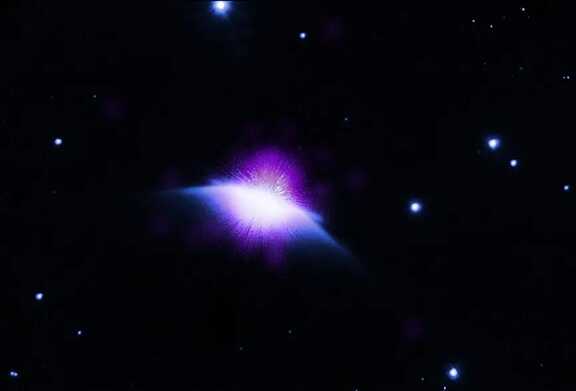
By combining X-ray data from NASA’s Chandra Observatory with infrared and optical data from the Hubble telescope, scientists have managed to create an extraordinary portrait of this stellar wind bubble.
At the centre of the image, a bright white X-ray core is visible, surrounded by neon purple light marking the presence of the astrosphere. However, the most striking feature of HD 61005 is its wedge-shaped dust tail resembling a pair of wings, earning the star the nickname “The Moth”. These wings are formed from the remnants of star formation that have been swept backwards as the star hurtles through space.
“There is a saying about moths being attracted to fire,” said Brad Snios, a physicist formerly with the Harvard & Smithsonian Center for Astrophysics. “In the case of HD 61005, the ‘Moth’ cannot easily escape from the fire because it was born around it.”
Despite having mass and temperature similar to the Sun, HD 61005 is far more active. Its stellar wind is estimated to be three times faster and 25 times denser than our current solar wind. According to NASA simulations, if this star were to replace the Sun’s position, our heliosphere width would expand tenfold.
The effort to capture images of alien astrospheres has been a long mission since the 1990s. This breakthrough was finally achieved because the strong wind from HD 61005 collides with an extremely dense region of interstellar matter, producing X-rays strong enough to be detected by the Chandra telescope.
This discovery is far more than a beautiful photograph in space. It is the first clue about what may have surrounded our Solar System billions of years ago, and provides insight into how young planetary systems evolve in their cosmic environment.