
First ASN WFH on Friday: Situation in Ministry of Finance and Ministry of Public Works
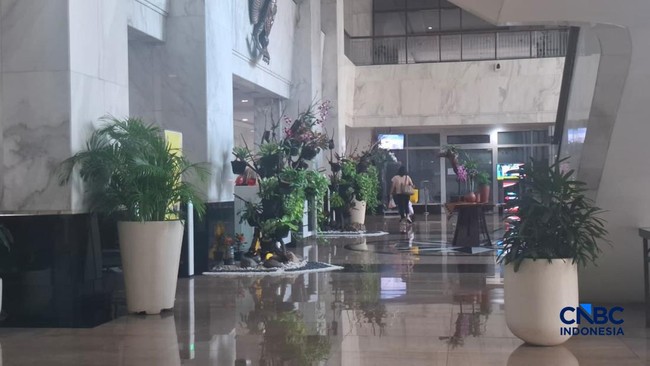
The government has mandated that civil servants (ASN) work from home (WFH) once a week every Friday. This policy takes effect for the first time today, Friday (10/4/2026). The hope is that this policy can save on state budget and fuel amid global turbulence due to the war in the Middle East. From CNBC Indonesia’s observations, several ministries appear emptier. One of them is the Ministry of Finance (Kemenkeu) office. The Djuanda I Building of Kemenkeu currently looks quiet. Meanwhile, based on CNBC Indonesia’s observations at the Ministry of Housing and Human Settlements (PKP) office, located in the Wisma Mandiri building, Central Jakarta today, the situation still appears relatively normal. This is because the Ministry of PKP is in the Wisma Mandiri building, so employees working there include those from outside the Ministry of PKP. The car park in front of the Wisma Mandiri building also still looks normal. As for the ASN of the Ministry of PKP, many can still be seen coming to work today. Meanwhile, Minister of PKP Maruarar Sirait and her team are currently visiting North Sulawesi to inspect housing programmes. For information, the government has begun implementing the WFH policy for ASN one day per week, namely every Friday. This policy is taken as a step towards energy efficiency amid global conflict dynamics. In addition to WFH, the government is also limiting the use of official vehicles and encouraging ASN to use public transport. An interesting finding was also observed at the Ministry of Public Works (PU). CNBC Indonesia found that this ministry is still running its normal work system, without WFH. Minister of Public Works (PU) Dody Hanggodo confirmed that there is no work from home (WFH) policy for his staff. This decision was taken considering the strategic role of the ministry in handling infrastructure as well as disaster response in various regions. “PU, in addition to building infrastructure, we are also part of the main team when there is a disaster, together with BNPB, Basarnas, and BPD. Therefore, it was decided that we would not WFH,” said Dody at the Ministry of PU, Friday (10/4/2026). In the current situation, the Ministry of PU is deemed unable to relax the physical presence of employees, especially due to direct involvement in the field. Cross-agency coordination is also a crucial factor that demands constant readiness. Nevertheless, the government is still seeking ways to maintain operational efficiency without disrupting core performance. “But it was indeed decided that we strive to work effectively and efficiently. What we do after 5 pm, for example, after 5 pm we reduce electricity completely, we reduce AC. So for rooms that can use AB, natural breeze, just use AB, no need to use AC,” said Dody. These saving measures are said to be part of efforts to support state budget efficiency. Reducing electricity and room cooling usage becomes one simple method implemented in the office environment. This policy is also currently being evaluated to measure its impact on expenditure. “So hopefully with that method, even though we are not WFH, there is still efficiency that we can provide to the state treasury. That is something that will be measured by Karobim. So if WFH at PU, no, there is none,” said Dody.