
Fire Horse: SBY's Message to the Nation
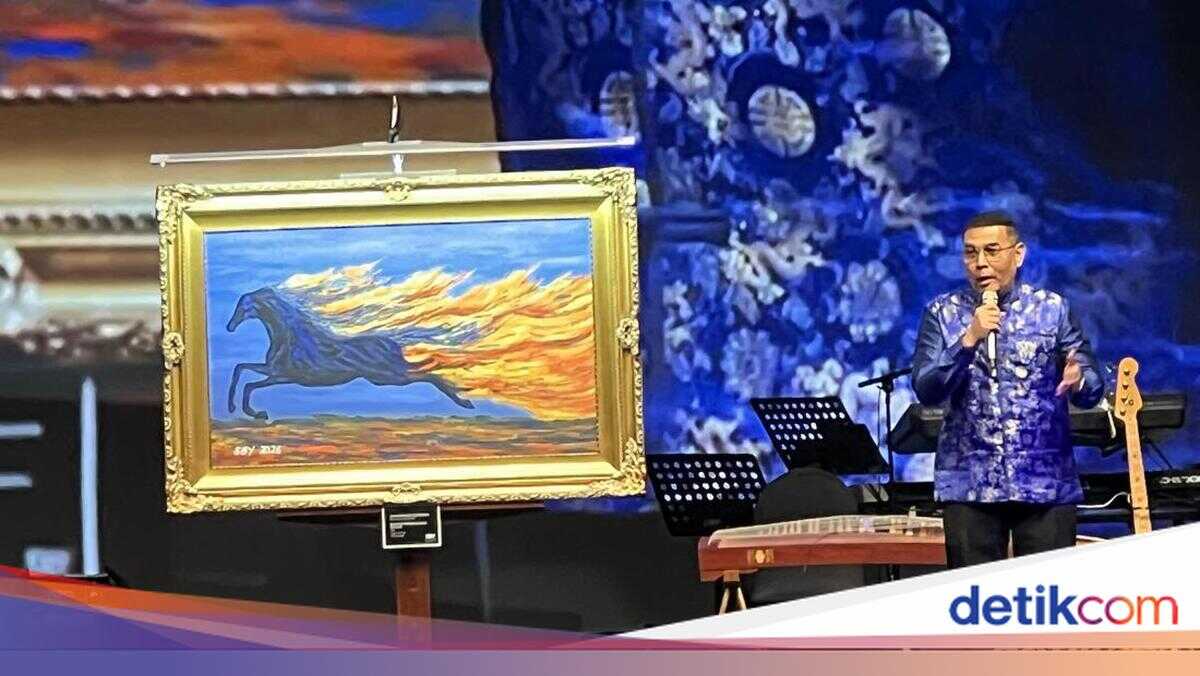
Amid a political landscape increasingly dominated by instant opinion and fleeting emotion, a painting speaks in a far quieter yet profoundly deeper manner. The painting “Fire Horse” by Susilo Bambang Yudhoyono (SBY), auctioned during the Democrat Party’s Chinese New Year celebration at Jakarta Theater on 18 February 2026, is more than merely a work of art by a former president.
It is a symbolic declaration — indeed a reflection on statesmanship — not simply about the importance of maintaining unity and solidarity in pursuit of shared aspirations, but about how the energy of power ought to be understood, managed, and directed in national life.
Art, at certain moments, often becomes the most honest language available to a statesman. When political words lose their force from being too frequently deployed in debate, and when the right to speak and narratives of truth are constrained, symbols rediscover their power.
Fire Horse arrives not to explain, nor to correct, but to invite reflection. A moment for retreat, for contemplation. It does not lecture, but touches a deeper domain: the ethics of leadership. Not domination but communication; not monologue but dialogue — borrowing from Habermas’s political philosophy.
Throughout the history of civilisation, the horse has almost always symbolised motive force. It represents the journey, resilience, and leadership that carries humanity across distance and time.
Fire, meanwhile, is a symbol of primal energy: a source of life, enlightenment, and equally of destruction. Fire warms, but it also burns. When horse and fire are united on a single canvas, a deliberate paradox is born — that the greatest power is never neutral; it always demands moral control.
It is here that Fire Horse finds its relevance to Indonesia today. The nation is moving rapidly. The demographic bonus, ambitions for economic growth, technological acceleration, and increasingly intense political dynamics are generating enormous social energy. Yet history, both national and global, teaches a consistent lesson: speed without direction ends in chaos, and energy without ethics concludes in collective exhaustion.
The painting seems to convey a simple yet fundamental message: the nation requires leadership brave enough to burn brightly, yet sufficiently mature not to set fire to its own house. In politics, courage is indeed necessary — it is an imperative.
Without courage, Soekarno and Hatta would never have proclaimed Indonesian independence on 17 August 1945. Without courage, the nation would stagnate, marching in place. But courage unaccompanied by self-control will only produce damage that is costly — socially, politically, and institutionally.
For the Indonesian people, Fire Horse reflects a more subtle meaning, faint yet palpable. The fire in this painting is not anger, still less hatred. It is the flame of vitality — the spirit of labour, resilience, and optimism — that has long formed the foundation of this republic. The Indonesian people have proven they possess extraordinary energy to endure through crisis.
Yet that energy always requires direction. Sustainable change is never born from emotional eruption, but from consistent perseverance and organised effort.
The horse in the painting does not appear wild. It moves with full force yet remains under control. This is a powerful metaphor. Through it, the painter seeks to reaffirm something he has often stated: that the people are the nation’s primary source of energy, but that energy will only be meaningful if directed towards productive work, if used to seek and select genuine leaders who possess the capacity to lead — not towards social and political commotion. The state exists not to extinguish the people’s fire, but to channel it into the power of development.
The meaning of Fire Horse becomes sharper still when placed within the internal context of the Democrat Party. Before party cadres at the Chinese New Year event — attended by a majority of Chinese-Indonesian descent — the painting can also be read as a message of cross-generational leadership. That politics is not merely about seizing power, but about how power is exercised with moral responsibility. Political ambition is legitimate, even necessary.
Without ambition, a party will not only lose its fighting spirit but also its direction. Yet ambition unleashed without the restraint of values will incinerate political legitimacy itself.
In the leadership tradition that SBY has long cultivated, power has always been treated as a sacred trust. It is not an end in itself, but a means of maintaining stability, expanding prosperity, and nurturing diversity. Fire Horse becomes a visual metaphor for this principle: moving swiftly but not hastily; courageous but not savage; strong yet civilised.
This is the politics of civility that SBY has instilled in party cadres across the nation. At this juncture, the painting can be read as an allegory about the ethics of energy in national leadership. Every leader, every party, and every nation inevitably possesses fire — in the form of power, ambition, and the driving force of change. Yet history always teaches the same lesson: fire released without control will destroy, whilst fire directed with wisdom will illuminate the path.
This message feels ever more important in an era when politics is frequently reduced to battles of emotion, image, and the speed of response in digital spaces. In such circumstances, art emerges as a medium of warning. A painting does not shout, but it endures. It does not command, but invites thought.
Not the logic of mysticism but the logic of reason. Fire Horse invites us to pause and pose a fundamental question: what is this great energy we possess to be used for?
For Indonesia, that question is a call to ensure that the pace of change remains on course.