
Finding Work in Indonesia is Extremely Difficult, Turns Out This Phenomenon is Happening
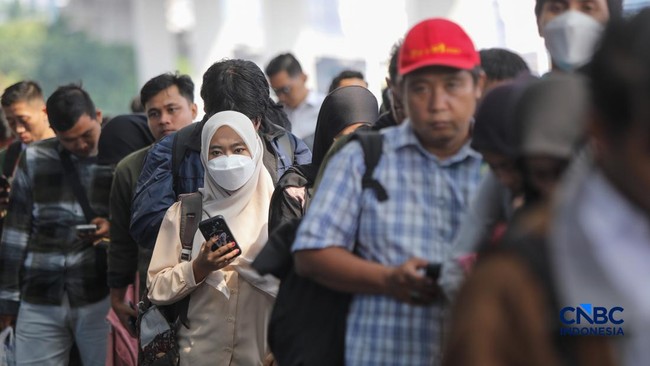
Jakarta, CNBC Indonesia - The performance of the industrial sector, which continues to grow in early 2026, has not been sufficient to drive employment absorption. Businesses are instead opting to hold back on recruitment, amid market uncertainties and lingering cost pressures.
Data from Bank Indonesia shows that manufacturing activity remains in the expansion zone. The Manufacturing Purchasing Managers’ Index (PMI) was recorded at 52.03% in the first quarter of 2026, up from 51.86% in the previous quarter. However, at the same time, the employment index is still at 48.76%, or in contraction territory, and this trend has persisted since the second quarter of 2025.
Signals of slowdown are also evident from the Business Activity Survey (SKDU). The Weighted Net Balance (SBT) for business activity was 10.11% in the first quarter of 2026, down from 10.61% in the previous quarter. Specifically in the processing industry sector, although business activity increased, employment usage is still contracting with an SBT of -0.47%.
Apindo General Chair Shinta Widjaja Kamdani explained that this situation reflects growth in production that has not fully indicated strong and sustainable demand. According to her, the current increase in industrial activity is largely driven by seasonal factors.
“First of all, it needs to be understood that the SKDU release for the first quarter of 2026 issued by BI is post-factum business performance that is seasonal in nature, because that business performance is influenced by various consumption momenta, from year-end consumption momentum carried forward, Chinese New Year momentum, to Ramadan and Eid momentum,” Shinta told CNBC Indonesia on Sunday (26/4/2026).
She emphasised that this seasonal pattern leads companies to only increase production to meet short-term demand spikes, not for long-term expansion. Therefore, the need for additional labour is not a priority.
“Why doesn’t this expansion boost employment absorption? The answer is because of the seasonal factors I mentioned earlier. Generally, business actors do not open up job opportunities just because of seasonal production needs, which will correct themselves once that momentum ends,” she said.
Shinta stated that business actors are currently tending to use medium-term market conditions as the main reference in making business decisions, including on labour. Over the past year, market conditions have not been sufficiently conducive, either domestically or globally.
“It should be noted that business performance over the past year has put considerable pressure on overall market performance, both domestic and foreign markets,” she said.
Amid these conditions, businesses are also facing rises in various cost components, from energy and logistics to financing. This makes companies even more cautious in expanding, including opening new jobs.
“Because market conditions over the past year have not been sufficiently conducive and the outlook for business performance growth in 2026 is also not very optimistic, plus considerations of inflation and other business burdens, business actors are generally holding back from expanding employment at this time,” said Shinta.
According to her, the strategy currently taken by business actors is more focused on efficiency and optimisation of existing capacity, rather than expanding new employment.
“Now business actors tend to focus on business cost efficiency and intensification of using existing business resources,” she said.
In addition to demand and cost factors, the structure of formal sector employment is also a consideration. The burdens that arise, including the risk of costs when layoffs (PHK) occur, make companies increasingly selective in recruiting.
“Especially considering that in Indonesia, the burden of labour in the formal sector is quite high,” she said.
On the other hand, indicators of business confidence for expansion also show caution. Shinta explained that the Weighted Net Balance (SBT) in the Business Activity Survey (SKDU) essentially reflects the appetite or willingness of the business world to expand, including in terms of financing.
“This context also applies to the assessment of the SBT for the first quarter of 2026 issued by BI. It should be remembered that SBT is an indicator of the appetite or confidence of business actors to carry out business credit expansion,” she explained.
Considering the still weak market conditions, high cost pressures, and relatively expensive financing costs, business actors assess that expansion at this time may not be sustainable in business terms.
In this situation, Apindo believes more concrete policy interventions are needed to encourage the business world to become expansive again. From macroeconomic stabilisation, inflation control, to improving the business climate, these are seen as key factors.
“So the interventions we need from the government at this time include stabilising the national macroeconomic conditions to better support business expansion,” said Shinta.
In addition, simplification of regulations and reductions in various business burdens such as energy, logistics, and financing are also considered important to increase business resilience. The government is also expected to expand access to more affordable financing, especially for labour-intensive sectors that have the potential to absorb large numbers of workers.
Not only that, government spending is also expected to be more directed towards productive sectors, as well as strengthening connectivity and industrial modernisation. Amid global pressures, trade diversification is also seen as an important strategy to maintain supply stability and strengthen exports.