
Financial Recovery, Additional Fiscal Space, and the Essence of Welfare
Financial Recovery, Additional Fiscal Space, and the Essence of Welfare
Note: This article is the personal opinion of the author and does not reflect the views of the CNBCIndonesia.com editorial team.
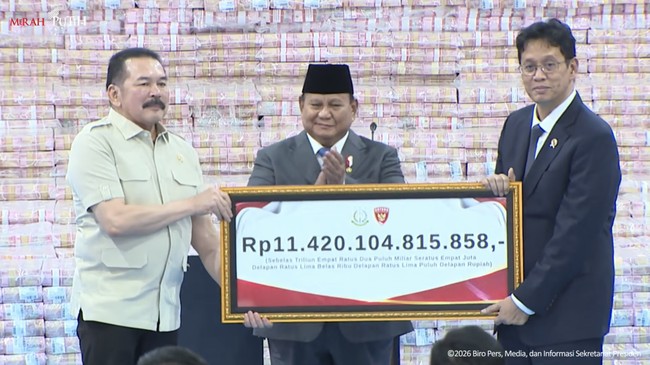
During the handover ceremony of administrative fines, state financial recovery, and the repossession of forest areas phase VI at the Attorney General’s Office in Jakarta on 10 April 2026, President Prabowo Subianto stated that the Forest Area Enforcement Task Force had saved state forest assets worth Rp 370 trillion. This figure is nearly equivalent to 10% of the total State Revenue and Expenditure Budget (APBN), which stands at Rp 3,700 trillion.
At the event, the Attorney General’s Office handed over Rp 11.42 trillion to the state, collected from administrative fines. The breakdown includes Rp 7.23 trillion from forestry administrative fine collections, Rp 1.96 trillion from Non-Tax State Revenue (PNBP) from handling corruption crimes by the Republic of Indonesia Prosecutor’s Office, Rp 967.77 billion from tax deposits for the period from January to April 2026, state revenue through tax deposits on 28 February 2026 from PT Agrinas Palma Nusantara amounting to Rp 108.57 billion, and Rp 1.14 trillion from PNBP environmental fines. (Ministry of State Secretariat, 10/4/2026)
Progressiveness
If we analyse the various anti-corruption strategies in the Prabowo era, these achievements reflect the optimisation of asset recovery functions within Indonesia’s criminal justice system. From a legal perspective, this aligns with the mandate of Law No. 31 of 1999 as amended by Law No. 20 of 2001 on the Eradication of Corruption Crimes, which not only emphasises the punishment of perpetrators but also the return of state losses as an integral part of law enforcement objectives. In fact, in practical developments, this approach is further strengthened through administrative fines, asset forfeiture, and the optimisation of Non-Tax State Revenue (PNBP).
Furthermore, from the perspective of state financial governance, these steps reflect the strengthening of the “value for money” principle in managing law enforcement outcomes. The state not only acts as an “enforcer” but also as a “restorer” ensuring that every rupiah saved returns to the national fiscal cycle. In this context, revenues from forestry fines, environmental fines, and PNBP from corruption case handling demonstrate the integration between criminal law regimes, administrative law, and state financial law.
This mechanism also correlates with the mandate of Law No. 17 of 2003 on State Finances, which stipulates that all state revenues, including those from law enforcement, must be recorded and managed accountably within the APBN. Thus, the Attorney General’s Office’s actions not only impact law enforcement aspects but also directly contribute to strengthening the state’s fiscal capacity.
The Rp 11.42 trillion achievement is not merely viewed as a statistical figure but as an initial indicator of a more modern, accountable, and public welfare-oriented transformation in law enforcement. Ultimately, the success of law enforcement finds its meaning when it can return state rights, and in turn, return them to the people in the form of public services, development, and social justice.
Imagine the profound social impact created if law enforcement does not stop at verdicts but truly culminates in state financial recovery. At that point, the law is no longer perceived as an instrument distant from people’s lives but is present concretely in the form of built roads, improved public services, more affordable education, and increasingly inclusive social guarantees. The people do not just “hear” about anti-corruption efforts but “feel” the results directly in their daily lives. Herein lies the foundation for the legitimacy of the law and public trust.
Within this framework, the optimisation of the roles of the Attorney General’s Office, KPK, and Police becomes crucial. Synergy among law enforcement agencies must move from mere procedural coordination to strategic integration based on data, financial intelligence, and modern case management.
The “hard work and smart work” approach is no longer sufficient to be interpreted merely as the intensity of enforcement but also encompasses precision in asset tracing, effectiveness in asset recovery, and consistency in closing systemic leakage gaps that allow corruption to recur (state capture corruption).
Ongoing Enforcement
If we think more reformist, this demands the strengthening of institutional design that ensures independence as well as accountability; political will is needed to ensure that every law enforcement institution not only has adequate authority but is also supported by oversight systems, internal integrity, and interoperability among institutions.
This view aligns with findings from the Public Integrity Journal in the article: “It all comes back to self control? Unpacking the Discourse of Anti-corruption Education in Indonesia,” by Teguh Wijaya Mulya and Kanti Pertiwi (2024). The research emphasises that anti-corruption efforts cannot rely solely on narratives of individual heroism.
An approach that overly emphasises individual morality risks ignoring more fundamental structural issues. Instead, what is needed is “institutional heroism,” namely the capacity of institutions to work systemically, consistently, and sustainably in closing corruption spaces. (Public Integrity Journal, 2024)
Thus, the culmination of all these efforts is not merely an increase in the number of handled cases or the value of recovered state losses, but the realisation of welfare.