
Finance Minister Purbaya Establishes Rules for OJK Budget Management: Full Details
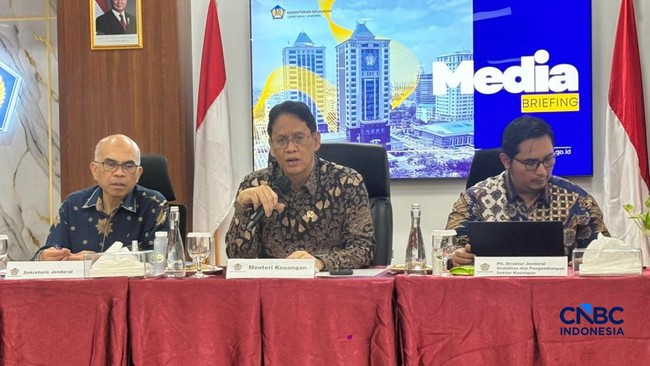
Finance Minister Purbaya Yudhi Sadewa has established specific provisions governing the management of the Financial Services Authority (OJK)’s budget. These provisions are set forth in Ministerial Regulation on Finance (PMK) No. 27 of 2026, effective from 24 April 2026.
This PMK forms part of new regulations to implement the provisions of Article 5 paragraph (3), Article 33 paragraph (8), and Article 34 paragraph (7) of Government Regulation No. 41 of 2024 on the Work Plan and Budget of the Financial Services Authority and Levies in the Financial Services Sector.
“It is necessary to regulate the coordination procedures between the Ministry of Finance and the Financial Services Authority, the requirements and procedures for submitting pure rupiah, and provisions regarding assistant state budget users of the State General Treasurer and authorised state budget users of the State General Treasurer as part of the guidelines in preparing the Financial Services Authority’s budget,” as stated in PMK 27/2026, quoted on Monday (27/4/2026).
Article 3 of PMK 27/2026 reaffirms that the OJK’s budget is part of the State General Treasurer’s budget allocation in the State Budget (APBN). Its preparation is discussed by the Financial Services Authority with the House of Representatives (DPR), and its determination is based on DPR approval.
The PMK also emphasises that, prior to the preparation and determination of the OJK’s budget, the OJK Board of Commissioners is required to coordinate with the Minister of Finance when drafting the annual Work Plan and Budget. The aim includes harmonising OJK’s programmes with government programmes.
Additionally, it regulates the involvement of the Directorate General of Financial Sector Stability and Development (DJSPSK) of the Ministry of Finance to assess the general overview of the work plan, budget needs, and funding sources, including data on the OJK’s planned and realised budgets.
“The Director General of Financial Sector Stability and Development submits the assessment results as referred to in paragraph (5) to the Minister,” as stated in Article 5 of PMK 27/2026.
The regulation also governs OJK’s budget provisions derived from pure rupiah or allocations in the APBN not originating from non-tax state revenues (PNBP), foreign or domestic loans or grants, direct grants, or project-based state sharia securities.
Furthermore, it addresses OJK’s role as a partner to government agencies in managing PNBP. The PNBP managed by OJK under this PMK consists of levies in the financial services sector and other receipts. These levies are amounts mandatorily paid by financial services institutions or individuals or entities conducting activities in the financial services sector.
Meanwhile, other receipts consist of administrative sanction receipts in the form of fines for violations of legislation in the financial services sector; proceeds from the management or storage of levies and other receipts; fines related to procurement of goods and services; proceeds from asset utilisation; and other lawful receipts in accordance with legislation.
These levies and other receipts may be used in part or in full directly by OJK to meet funding needs for operational, administrative activities, asset procurement, and other supporting activities, as well as to improve service quality.
If at the end of the fiscal year the proceeds from levies and other receipts are not fully utilised, they may be carried over to the following year. However, if they remain unutilised in the subsequent year, OJK must deposit the remaining proceeds from levies and other receipts into the state treasury.
“The remaining proceeds from levies and other receipts deposited into the state treasury as referred to in Article 26 paragraph (3) constitute PNBP,” as stated in Article 27.
The amount of remaining levy proceeds or other receipts deposited into the state treasury is adjusted based on OJK’s audited annual financial statements and must be deposited no later than 10 working days after the audited financial statements are received by OJK.