
Finance Minister: Expenditure for Free Nutritious Meals Programme Ensured to Be More Efficient
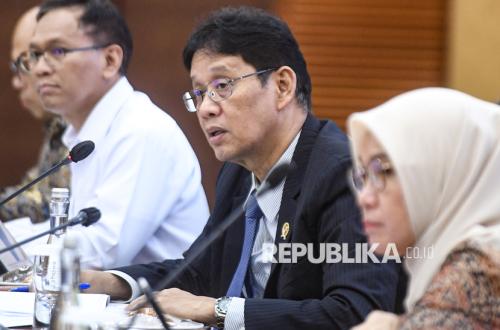
Finance Minister (Menkeu) Purbaya Yudhi Sadewa has assured that expenditure to support the Free Nutritious Meals (MBG) programme will be carried out more meticulously and efficiently. This more efficient spending, he continued, involves scrutinising the precise budgetary needs so that this key government programme can run smoothly and provide wider benefits to society.
“This is a programme that continues to operate. We are ensuring that its spending is more efficient,” said Finance Minister Purbaya during the APBN KiTa press conference in Jakarta on Tuesday (5/5/2026).
Furthermore, Finance Minister Purbaya stated that budget realisation for the MBG programme up to 31 March 2026 amounted to Rp55.34 trillion, or 16.5% of the 2026 State Revenue and Expenditure Budget (APBN) allocation for this programme, which totals Rp335 trillion.
On the other hand, the Central Statistics Agency (BPS) records that MBG has contributed to Indonesia’s economic growth, recorded at 5.61% year-on-year in the first quarter of 2026.
Based on reports, MBG’s contributions are reflected, among others, in the Gross Fixed Capital Formation (PMTB) component, in line with the construction of supporting infrastructure for Nutrition Fulfilment Service Units (SPPG).
According to BPS, the addition of SPPG units also has a positive impact on PMTB due to physical construction activities.
In addition, investments in SPPG are recorded as part of capital expenditure, both for building kitchens and providing supporting equipment.
Overall, BPS notes that PMTB is the second largest contributor to economic growth after household consumption, with a contribution of 1.79%.
This component also grew by 5.96%, driven by government investment, including the construction of national priority programmes, as well as private investment. PMTB’s contribution to gross domestic product (GDP) reaches 28.29%.