
Final Trading Day Before Extended Holiday: IHSG Movement Forecast
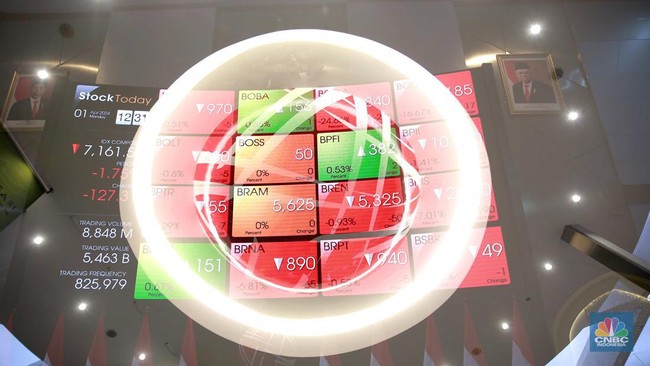
Jakarta — Today, Tuesday 17 March 2026, will be the final day that Indonesia’s financial markets are open before the extended holiday period for Nyepi and Eid Al-Fitr 2026.
The Composite Stock Price Index (IHSG) is expected to move within a limited range as trading activity becomes sparse and negative sentiment persists in the market.
In trading on Monday 16 March 2026, the IHSG recorded a correction of 1.61% to the level of 7,022.28. Calculated from the beginning of the year, Indonesia’s stock market index has experienced a correction of approximately 18.79%, marking the worst performance across Asia.
From an external perspective, the sentiment influencing the movement of Indonesia’s stock market is not substantially different from what is occurring in various regional exchanges.
One of the main factors is escalating geopolitical tensions in the Middle East, which are driving increases in global crude oil prices.
The weakness of the IHSG is not assessed as stemming from a single factor, but rather represents an accumulation of several negative sentiments that have emerged almost simultaneously.
The conflict in the Middle East, for example, not only triggers a surge in energy prices but also increases uncertainty in global financial markets.
On the domestic side, the market is also shadowed by issues related to MSCI concerns regarding Indonesia’s market structure, as well as downgraded outlooks from several global rating agencies.
In these conditions, the market is assessed as lacking a sufficiently strong catalyst to withstand pressure as occurred in previous periods.
The movement of conglomerate stocks has also become relatively limited as regulator attention towards market dynamics related to MSCI issues increases.
Furthermore, pressure also originates from large-capitalisation stocks, particularly the banking sector, following downgraded outlooks for several banks due to increased risk perception from both political and macroeconomic perspectives.
With these various sentiments, the market is assessed as lacking a sufficiently strong catalyst to prompt the IHSG to reverse direction in the near term.
Looking ahead, if energy prices remain elevated and the government needs to implement policy adjustments concerning fuel prices or the fiscal deficit, pressure on the rupiah, bond market, and the IHSG has the potential to continue.
However, should geopolitical tensions subside and crude oil prices stabilise below US$100 per barrel, some of the pressure on the domestic financial market could ease and open opportunities for IHSG recovery from the 7,000 area.
From a technical perspective, the 7,000 level is viewed as an important support area for the IHSG.
Should that level be breached, the index could potentially continue its correction towards 6,890.
In the short term, the IHSG is estimated to move within a range of 6,900 to 7,150 in subsequent trading.