
Final Moments of Dying Star Captured by Hubble and Euclid Telescopes
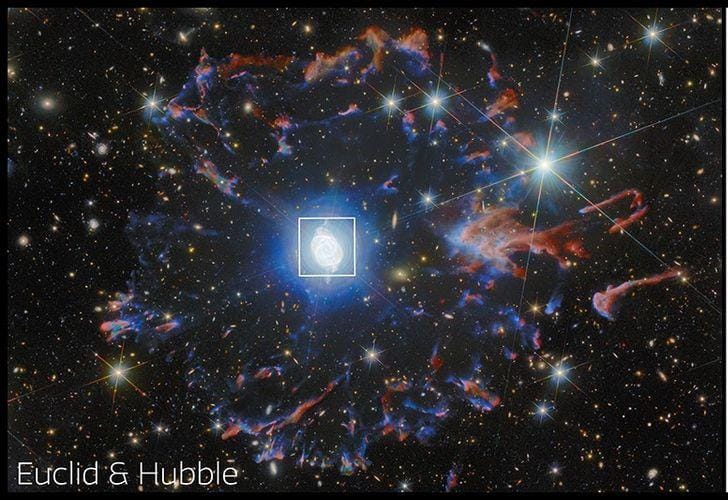
The Hubble Space Telescope and Euclid Space Telescope have successfully captured the dramatic phase of a star’s death. The two observatories released latest images of the Cat’s Eye Nebula, a nebula formed from the outer layers of a star that are shed as the star enters the final stage of its life.
The nebula is located approximately 4,300 light-years from Earth in the constellation Draco. In the latest images released by NASA and the European Space Agency, a complex gas structure is visible, consisting of bright layers, thin filaments, and gas bubbles that appear to burst outward from the centre of the nebula.
Astronomers describe this image as one of the most detailed depictions of how a star like the Sun ends its life.
The collaboration between Hubble and Euclid provides different but complementary perspectives. Hubble photographs the nebula’s core with extremely high resolution. From these observations, scientists can see intricate structures around the central star, including high-speed gas emissions and overlapping bubbles of material.
Meanwhile, Euclid captures a much wider region around the nebula. This telescope reveals a fainter gas halo and layers of material ejected thousands of years earlier. Euclid’s images also display hundreds to thousands of distant galaxies in the background, providing a much grander perspective of the scale of the cosmos.
In other words, Hubble shows the micro-level details of stellar death, while Euclid reveals the broader cosmic context.
The layered structure visible in the Cat’s Eye Nebula actually contains a record of the star’s evolutionary history. Each ring or gas bubble marks a phase when the star released its outer layers.
This process occurs when a star begins to run out of nuclear fuel. Without sufficient energy to maintain stability, the star’s outer layers are pushed out into space. The material subsequently becomes luminous due to radiation from the remaining star core, forming an object known as a planetary nebula.
Unlike massive stars that die through supernova explosions, stars with mass similar to the Sun end their lives more gradually. They release gas layers incrementally over thousands of years before eventually leaving behind a dense core called a white dwarf.
Observations of the Cat’s Eye Nebula also provide insight into the Sun’s future. Scientists estimate that the Sun will undergo a similar process in approximately five billion years from now.
When this occurs, the Sun will form a luminous nebula that may be visible from other star systems in the galaxy. The released gas will disperse into interstellar space and become raw material for the formation of the next generation of stars and planets.
The combined images from Hubble and Euclid show that stellar death is not merely an ending, but part of a cosmic cycle that continually reshapes the universe.