
Field of Intolerance
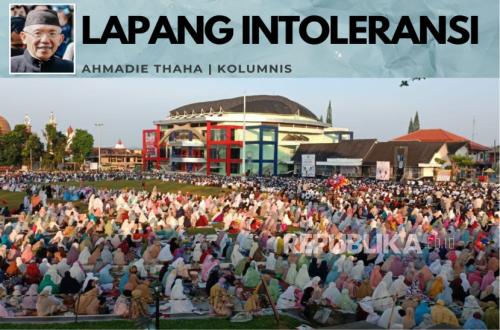
Eid al-Fitr always arrives with a miracle that no economic theory can explain. It gives birth to forgiveness inflation. People who are stingy with smiles all year suddenly become generous in forgiving. Those who usually find it as hard to apologise as finding a signal in the depths of the forest suddenly flow smoothly like fast WiFi. Everything feels light. Everything feels spacious.
However, this year, in the city named Sukabumi, an area long known as the city of ulama and santri, a phenomenon has emerged that furrows brows once again. And hearts wonder: since when has prostrating to Allah SWT been forbidden in public fields? In this city, a similar ban occurred under the previous leadership, and the mayor was not re-elected.
The story is simple, but its impact is complex. Muhammadiyah residents intended to perform Eid al-Fitr prayers on Friday (20/3/2026), following the hisab method they have long used, even developed into a global approach. Nothing new. Nothing revolutionary. This practice is traditional, even older than some of our government buildings.
Yet what happened was beyond everyday logic. Lapangan Merdeka, a public space that has long been friendly for all activities, from morning exercise, selling snacks, to community events, suddenly turned selective. It was as if it had gained new awareness: allowed for morning jogs, but not for running towards God.
The reason given by the local government sounded solid. Namely, obedience to the constitution and compliance with the central government’s decision through the isbat session. The mayor even explained quite honestly that during his campaign, he had a more open personal view, perhaps meaning more tolerant. But after being inaugurated, he is bound by statutory regulations.
He emphasised that this decision is not about intolerance, but about fulfilling the mandate of his position. He even attended the relocated Eid prayer location, greeting the congregation, offering congratulations, and trying to show that personally, he still respects them. A gesture worth noting, although the substance of his policy still leaves question marks.
At this point, we need to pause for a moment, not to judge, but to understand. Perhaps, behind that decision, there is the classic bureaucratic dilemma, between implementing rules textually or understanding their substance. Between fearing being seen as violating regulations or daring to interpret wisely. Or perhaps the mayor is hesitant in understanding the existing provisions.
Yet it is here that the irony grows fertile. The constitution cited as the reason for banning Eid prayers in a public-owned field is actually an umbrella for protecting religious freedom, not a fence limiting worship. The isbat session, which should serve as guidance, has turned into what seems like a singular standard that cannot be exceeded.
In fact, this nation has long lived in harmony with differences in rukyat and hisab methods, two approaches equally born from valid Islamic scholarly traditions. Muhammadiyah is not a group that appeared yesterday afternoon. It is part of this nation’s long history, which has helped build and nurture the republic since its founding.
Thus, when residents want to pray at Lapangan Merdeka, a public field that belongs to all and is maintained from public taxes, a simple question arises. Which rule is violated? Which constitution is deviated from? Or is this merely an interpretation or excessive concern lost in the corridors of bureaucracy?
For comparison, let us look to Denpasar, a city on the Island of the Gods, Bali. This year, Eid al-Fitr even overlapped with the sacred Nyepi holiday for Hindus. The situation was far more sensitive, not just a difference in methods, but an encounter of two major cross-religious traditions in nearly simultaneous space and time.
Yet what happened was the opposite. No commotion. The local government did not prohibit it. Lapangan Renon was still used by Muhammadiyah residents for Eid prayers. Even the pecalang, Bali’s customary guardians, helped ensure the site’s security during the Nyepi period. Ustadz Sya’ban in his sermon called for Islamic brotherhood, emphasising that differences in dates should not fracture unity.
Everything proceeded orderly, calmly, even beautifully. The Eid prayer took place orderly in a short time. Without drama. Without bans. Without a field suddenly having an ideology. A quiet lesson that maturity is not measured by the ability to uniformise, but by the courage to nurture differences without losing respect.