
Far from the Middle East: Indonesia's Stock Exchange Suffers the Most, While Arabs Laugh
Geopolitical tensions in the Middle East are currently the primary driver of global financial market movements over the past month. The outbreak of conflict involving the United States (US), Israel, and Iran has triggered concerns over the stability of the world’s energy supply chain.
Threats of disruption to major global distribution routes, particularly around the Strait of Hormuz, have driven crude oil prices to surge significantly to US$100 levels. This situation is forcing all stakeholders to confront the risk of inflation spikes that were previously projected to ease.
According to Christine Lagarde, President of the European Central Bank, the current state has the potential to persist due to the severe damage to the Middle East’s energy ecosystem. Returning to normal conditions is estimated to take 1 to 5 years, she said, given the extent of the damage in the Middle East.
Domino Effect on Equity Markets
This energy inflation threat is altering market expectations regarding the direction of global central bank interest rate policies, particularly those of the Federal Reserve. Fears that the era of high interest rates will be maintained longer have sparked a massive wave of risk aversion.
Global liquidity is observed flowing out of high-risk assets, especially in emerging markets, and pouring into energy instruments and cash reserves amid the current movements.
It is also noted that projections indicate the Fed has a probability of over 30% to pivot and raise its benchmark interest rate at the FOMC meetings in Q3 and Q4 2026.
This massive capital rotation is clearly evident in the performance of stock exchanges in Asia and the Middle East over the period from 27 February to 27 March 2026. With the current conditions, only a few countries in the Asian region have benefited so far.
The following is an overview of the five best and worst performing indices that represent this disparity.
Heavy Pressure on the Domestic Market
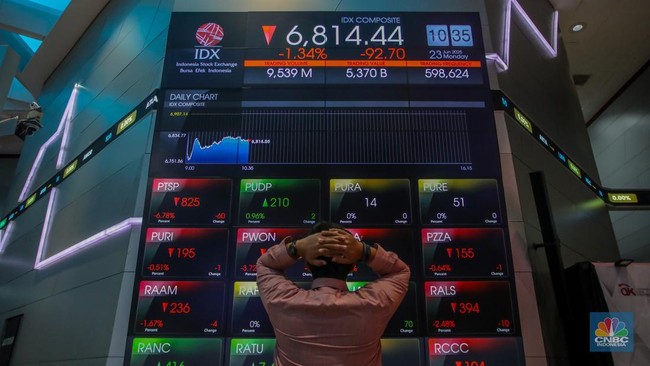
Referring to the data above, Indonesia’s equity market has been the most severely hit with a correction rate of 13.82%. The deepest decline in the region reflects the domestic market’s sensitivity to deteriorating macroeconomic indicators due to surging oil prices, which has triggered aggressive net selling by foreign investors.
Similar pressure has also struck other major indices such as those in Korea, Pakistan, Vietnam, and the Philippines, all recording weaknesses above nine percent, in line with the trend of foreign funds exiting Asian exchanges.
Resilience of Commodity Exporters
On the other hand, a positive anomaly is occurring in countries benefiting from the energy price rally. Saudi Arabia’s stock exchange leads with an appreciation of 5.73%, a direct response to the oil price surge that strengthens the country’s revenue prospects and economic fundamentals.
Strong performance is also shown by Laos, Mongolia, and Kazakhstan, which have managed to stay in positive territory. In Southeast Asia, Malaysia stands out with high resilience, limiting its decline to just 0.23% amid the onslaught of negative sentiment.
Market Prospects
Looking ahead, volatility in regional equity markets is projected to remain high. The direction of index movements will heavily depend on developments in diplomatic efforts in the Middle East for each country, as well as the ripple effects on strategic commodity prices.
As long as this geopolitical uncertainty looms, a defensive stance among stakeholders is expected to continue dominating daily transaction volumes due to investors’ needs for capital preservation strategies and a wait-and-see approach amid the current global uncertainty.