
Fallen Soldiers and a Question About Peace
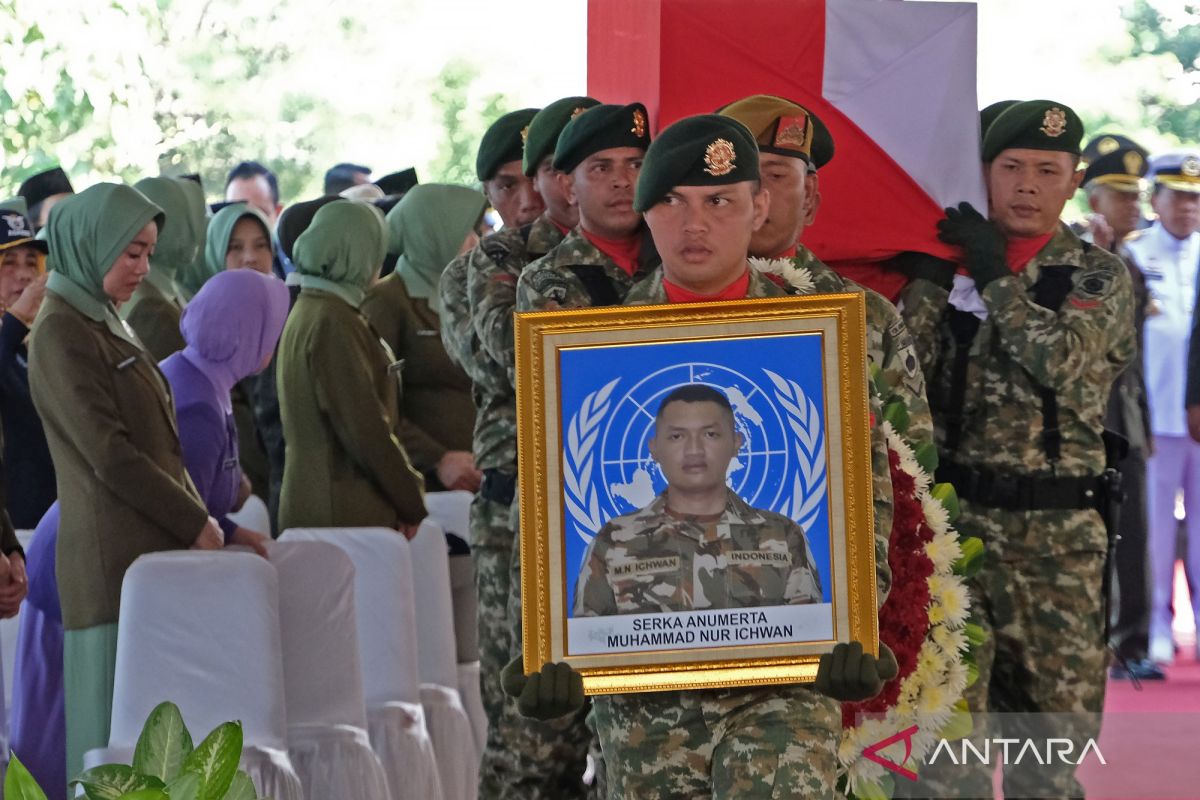
Behind every soldier who departs, there is a family waiting with a simple hope: a safe return.
Jakarta (ANTARA) - Few Indonesians know the exact location of Adchit al-Qusayr or Bani Hayyan on the world map. Those names sound distant, almost foreign. They feel like small dots with no direct connection to daily life in Jakarta, Makassar, or Padang.
However, in late March 2026, that distance suddenly collapsed. Not through travel or encounters, but through news of sorrow.
From that small area in southern Lebanon came the tragic news. Three Indonesian National Armed Forces (TNI) soldiers fell in the United Nations (UN) peacekeeping mission. Chief Soldier Farizal Rhomadhon was killed by indirect artillery fire. A day later, an explosion struck a logistics convoy, claiming the lives of Captain Infantry Zulmi Aditya Iskandar and Sergeant First Class Muhammad Nur Ichwan.
On television news screens, the event appeared as an international report with a brief chronology, official statements, and condolences. In the fast flow of information, tragedies like deaths often present as facts that fade from public attention within moments, replaced by other news. Yet, stories of human deaths never truly end.
Every death has two stories: the public one and the personal one. The public story moves quickly, supplanted by the next. The personal story, however, sometimes only begins when the television is turned off and the house falls silent again.
In that story, there might be a child still waiting for the sound of their father’s footsteps at the door. There might be a partner slowly learning to speak only through memories.
At such times, the word “service” loses its heroic tone and becomes something far more real: a loss that cannot be replaced or fully understood.
It is at that point that “world peace” ceases to be an abstract concept. It descends from the realm of geopolitics and presents itself as a tangible human experience. An experience for those close ones left behind.
We may imagine peace as a calm state, a world without the sound of weapons and without fear. But the “peacekeepers,” like the three fallen soldiers, work in places where peace does not yet exist. They stand in the in-between areas, guarding the thin line that separates stability from chaos.
The presence of UN peacekeeping forces underscores that peace is not a settled state, but rather an ongoing effort, improved day by day, amid uncertainty.
Indonesia has chosen to be part of that effort from the beginning. Through the Garuda Contingent, Indonesia sends soldiers to various conflict zones around the world, including southern Lebanon, in the United Nations Interim Force in Lebanon (UNIFIL) mission. They patrol tense villages, monitor fragile ceasefires, and strive to ensure civilians can live without fear.
Of course, each time the Red and White flag flies in conflict territory, a collective pride emerges. It conveys the message that Indonesia is not merely a spectator in the world, but a participant in upholding humanity amid disputes.
The issue is that this pride always walks hand in hand with risk.
Behind every soldier who departs, there is a family waiting with a simple hope: to return. A hope that seems ordinary, but is in fact the most fundamental. No family truly prepares itself to accept the reality that a peacekeeping duty can end in a very different kind of return.
When the remains return to the homeland, grand concepts of geopolitics suddenly shrink. The complex international world contracts into the loneliness of a family room. It is there that the question about peace becomes deeply personal: is peace still worth it when it demands such a great sacrifice?
Bebas aktif