
Failed Rebound, IHSG Closes Down 0.61% Today
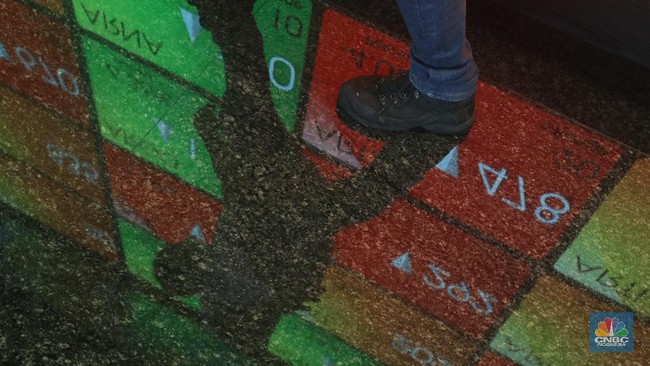
The Jakarta Composite Index (IHSG) ended in negative territory again today, Tuesday (31/3/2026). The IHSG closed down 0.61% or -43.45 points at the level of 7,048.22.
A total of 270 stocks rose, 435 fell, and 253 remained unchanged. The transaction value reached Rp14.92 trillion, involving 25.73 billion shares in 1.72 million transactions.
Throughout the day, the IHSG exhibited high volatility. It started trading in positive territory but then plunged into the red. The IHSG ultimately closed the first session with a correction, after having strengthened earlier.
According to Refinitiv, utilities, energy, and industrials were the sectors experiencing the largest corrections. This was in line with stocks such as Barito Renewables Energy (BREN), Bayan Resources (BYAN), and Energi Mega Persada (ENRG) becoming the main burdens on the IHSG.
Amid the IHSG volatility, foreign investors recorded a net sell of Rp878.5 billion in the first trading session. Indo Premier data showed foreign buying value at Rp2.4 trillion, while foreign selling was higher at Rp3.3 trillion.
Overall, foreign investor selling actions still dominated the first session trading, particularly in banking stocks and the energy sector. However, some big-cap stocks like BMRI, BBCA, and TLKM still recorded buying actions.
On the selling side, foreign investors offloaded the most BBRI shares with a sale value of Rp139.6 billion. This was followed by BRMS at Rp99.0 billion and BUMI at Rp69.2 billion. Foreign selling was also seen in MEDC shares at Rp51.3 billion and CUAN at Rp42.8 billion.
Meanwhile, the majority of stock exchanges in the Asia-Pacific region also weakened. South Korea’s Kospi suffered the worst, plunging 4.26%. Japan’s Nikkei also fell -1.58%. However, Hong Kong’s Hang Seng rose 0.15%.
The war between Iran and the United States and Israel, which has entered its fifth week, remains the primary source of global market anxiety, especially as disruptions in the Strait of Hormuz have not been fully resolved.
US President Donald Trump warned Iran again on Monday to open that route, amid uncertainty over diplomatic talks outcomes and still high military tensions.
For the market, developments in this war are very important because the Strait of Hormuz is one of the world’s vital energy trade routes.
Prolonged disruptions in the region continue to trigger concerns over crude oil and gas supplies, especially for Asia, which is highly dependent on energy flows from the Middle East. As long as this route has not fully recovered, the market will continue to incorporate a high risk premium into energy prices.
Domestically, State Secretary Minister Prasetyo Hadi conveyed a government statement regarding what is circulating in society about issues of planned adjustments or increases in fuel oil (BBM).
“That is why Pertamina has stated that it will not adjust prices for either subsidised BBM or non-subsidised BBM,” he said.
Prasetyo hopes that with this statement, the public can obtain clearer and more accurate information.
“And we hope the public does not need to panic or worry because BBM availability is guaranteed by us. We guarantee it. And there will be no price adjustments,” Prasetyo stated.