
Fadli Zon Says Ancient Muna Paintings Are Evidence of the World's Oldest Civilisation Traces from Indonesia
Indonesia is believed to possess the world’s oldest traces of civilisation following the discovery of ancient paintings approximately 67,800 years old in Liang Metanduno, Muna Island, Southeast Sulawesi. This finding is seen as strengthening the position of the Nusantara as one of the early centres of human civilisation development.
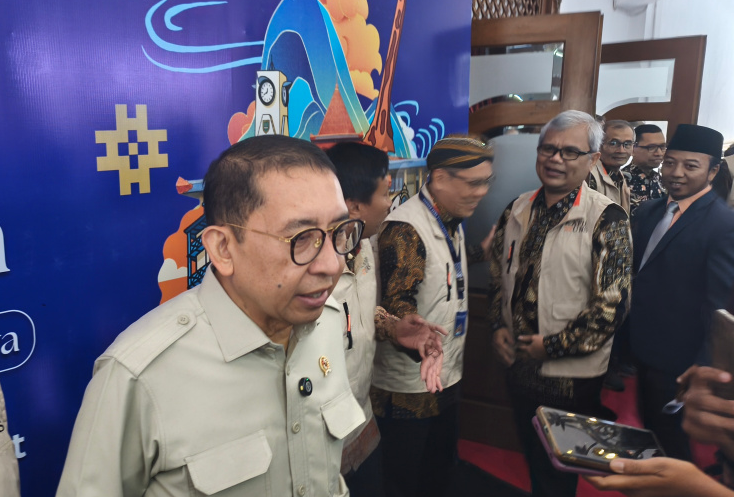
This assertion was made by the Minister of Culture, Dr. Fadli Zon, during a cultural oration at the “Gelar Budaya dan Karya Anak Bangsa” event organised by Sebelas Maret University (UNS) Surakarta as part of its 50th Dies Natalis. The event took place at the Haryo Mataram Auditorium, UNS Campus, on Thursday afternoon (26/3/2026).
According to Fadli Zon, these cave or prehistoric paintings indicate that traces of civilisation in the Nusantara may be older than similar discoveries in Africa or China, while also serving as an important contribution from Indonesia to world history.
“The traces of these 67,800-year-old ancient paintings send a message across time, that in the Nusantara, humans were already thinking symbolically, imagining, and even expressing themselves in the earliest phase of civilisation’s journey,” stated the minister, who is also a Gerindra Party politician, during the cultural oration attended by alumni of UNS’s Faculty of Letters.
He stated that the Ministry of Culture, together with stakeholders, has the responsibility to continue studying, protecting, developing, and responsibly utilising such cultural heritage.
The ancient cave paintings in Liang Metanduno were published in the scientific journal Nature in early 2026 as a result of collaboration between the National Research and Innovation Agency (BRIN) and Griffith University Australia. The cultural richness on Muna Island is considered a crucial milestone in understanding the development of Nusantara civilisation.
According to Fadli Zon, this discovery proves that creative power, symbolic imagination, and cultural expression have been present since the prehistoric era in Indonesia’s archipelago region.
“The civilisation traces we have certainly encourage the world to reread the map of culture and human civilisation history from a more complete and inclusive perspective, strengthening Indonesia’s position, particularly the Wallacea region, as an epicentre of human symbolic creativity,” he said.
He emphasised that research on the ancient paintings, consisting of hand stencils in Liang Metanduno, will continue to be explored to enrich global knowledge while affirming Indonesia as a region with very ancient civilisation traces and mega cultural diversity.
Research results show that these paintings are about 1,100 years older than prehistoric paintings in Spain and 16,600 years older than the cave art in the Maros-Pangkep area, South Sulawesi, which had previously been published.
“This is certainly not just good news for science, but also big news for Indonesian culture and our contribution to the world. In accordance with Article 32 of the 1945 Constitution, the state advances Indonesian national culture amid world civilisation, by guaranteeing the freedom of society to preserve and develop its cultural values,” he said, met with applause from the invited guests.
The Ministry of Culture positions this finding as a constitutional mandate as well as part of the national policy framework for advancing culture. Under his leadership, culture is said to be increasingly independent with various new discoveries of cultural richness from Sabang to Merauke.
On the same occasion, Fadli Zon also appreciated the organisation of the Gelar Budaya dan Karya Anak Bangsa by UNS. As part of the event series, performances of wayang beber tani and cultural exhibitions were held as a form of appreciation for national cultural creativity.