
Facts Speak: This is the String of Evidence That Trump is Waffling, Full of Lies
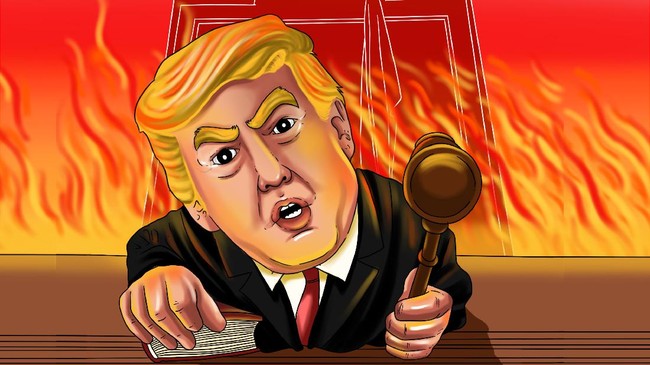
Jakarta, CNBC Indonesia - Entering the full month of the war between the United States (US) and Iran, US President Donald Trump has repeatedly made statements that sound firm, convincing, and even indicate that the war is about to end.
On several occasions, Trump has said the war is nearly over and portrayed Iran as if it has already lost much of its military capability. However, as the war approaches one month, his tone has changed. From initial threats, Trump has begun to highlight optimism that a peaceful path and negotiations are opening up.
The problem is that several of these claims do not fully align with the reality on the ground. The war has not truly stopped, Iran’s pressure persists, the Strait of Hormuz remains a source of disruption for global energy routes, and the talks described as promising have been denied by Tehran. This situation clearly shows the gap between Trump’s words and the war’s reality.
Trump Says Iran is Already Weak, But in Fact It Can Still Fight Back
This statement first appeared on 9 March 2026 in an interview with a foreign media outlet. At that time, Trump described Iran as an opponent nearly exhausted.
“They no longer have a navy, no communication, and no air force,” Trump said.
If we only look at those words, we get the impression that Iran is practically unable to mount any significant resistance.
However, what happened afterwards showed something different. Iran was still able to launch counterattacks, the conflict continued to widen, and Tehran’s ability to pressure the Middle East had not truly vanished.
Trump Claims Victory, But the War Continues
Two days later, on Wednesday (11/3/2026), Trump appeared at a rally in Hebron, Kentucky, and lobbed a victory claim.
“You never want to say you’ve won too quickly. We have won,” Trump said.
This statement sounds like a closing remark, as if the war is just waiting for final formalities.
But, in the same opportunity, Trump also said, “We don’t want to go too quickly, do we? We have to finish the job.”
From this alone, a difference is already apparent. On one hand, he claims victory, but on the other, he admits the operation is not yet complete.
Reality does not support the picture that the war is nearly over. After mid-March, tensions remained high. The US continued to increase troop deployments to the Middle East, while the Strait of Hormuz remained vulnerable for merchant ships, especially tankers, ultimately disrupting global energy flows.
Trump Says There Are Already Many Agreements, Iran Rejects Them
After several days of harsh tones, Trump began changing the direction of his rhetoric. This was evident in his statements on Monday (23/3/2026), when speaking to the media, Trump gave the impression that a peaceful path was opening up. Trump said there were already “many important points in agreement” and signalled that a deal could be reached soon.
However, when the proposal from Washington reached the Iranian side, the response that emerged was negative.
Iran deemed the contents of the proposal one-sided and unfair. This further shows that the gap between the two parties’ positions is still quite wide. Thus, the claim of many points of agreement is not yet truly reflected in the ongoing talks.
Trump’s Optimism on Peace Does Not Align with Iran’s Attitude
The day after, on 24 March 2026, Trump’s tone became even more optimistic. Speaking to reporters in the Oval Office, he said, “We are talking to the right people,” then added, “We are currently negotiating.” This statement gives hope that the war is moving towards a diplomatic path.
However, at the same time, the Iranian side denied that picture. From Tehran, it was acknowledged as merely an exchange of messages through mediators, not direct negotiations that have produced major breakthroughs. As a result, Trump’s optimism about peace appears to be advancing faster than the actual diplomatic developments.
Hormuz Situation Said to be Improving, But in Fact Still Vulnerable
Still on 24 March 2026, Trump also began giving the impression of positive developments in the energy route.
In his statement in the Oval Office, he said Iran gave the US a “very big gift” and emphasised that the gift was related to oil and gas, not nuclear issues.
Two days later, on Thursday (26/3/2026) in a cabinet meeting at the White House, Trump explained that what he meant was that Iran allowed several tankers to pass through.
This narrative gives the impression that tensions in the Strait of Hormuz are starting to ease. However, the big picture has not changed much. Hormuz remains a source of shocks in the energy market, oil prices are still surging from pre-war levels to above US$100 per barrel, and even the US government itself still places the security of the strait as a core part of its peace proposal. So, even if there are small signals on the ground, it is not enough to say the situation has recovered. The world’s oil route remains fragile.
While Talking Peace in Front, Trump Still Prepares Military Pressure
This contradiction became even clearer at the same time in the White House cabinet meeting. Trump again emphasised that Iran wants to reach an agreement.
But almost in the same breath, he also threw out a threat: “If not, we will continue to bombard them.” So, the message to the public becomes conflicting. Is Washington seriously opening a peaceful path, or is it still placing military escalation as its main language?
From the perspective of markets and diplomacy, messages like this only add to the uncertainty.
Trump Considers Energy Price Surge Not Severe, US Citizens Actually Pressured
Still in the same moment during the cabinet meeting at the White House, Trump also gave the impression that the surge in energy prices was not as bad as perceived.