
Facts of US Attack on Iran: Trump's Original Objective – Explosions Across Saudi Arabia
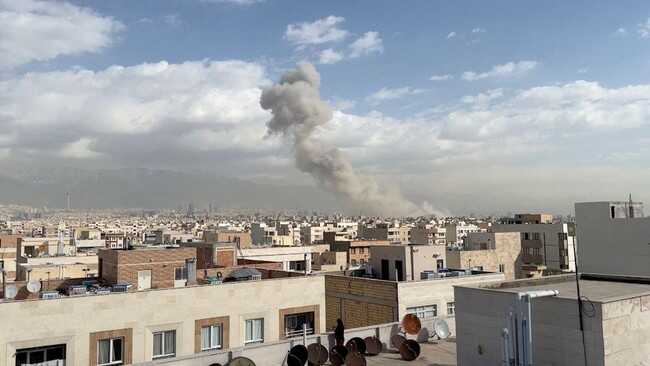
Escalation of tensions in the Middle East reached a critical peak after the United States and Israel launched a massive military offensive against various regions in Iran, including the capital Tehran, on Saturday 28 February 2026 local time.
US President Donald Trump formally announced the commencement of what he termed “major combat operations” against Iran.
The air strikes occurred amid deadlock in negotiations concerning Iran’s nuclear programme and ballistic missiles. The military action followed weeks of escalating threats from Trump and came just eight months after the US and Israel engaged in a brief 12-day conflict with Iran.
Tehran Burns and Strategic Targets
Initial reports indicated that missile strikes hit crucial points in the heart of Iran’s capital. According to the Fars News Agency, several missiles landed in the University Street area, the Jomhouri district, and areas near the headquarters of the Islamic Revolutionary Guard Corps (IRGC). The Associated Press also reported strikes near the office of Iran’s Supreme Leader, Ayatollah Ali Khamenei.
Beyond Tehran, massive explosions were reported across major cities including Kermanshah, Qom, Tabriz, Isfahan, Ilam, Karaj and Lorestan Province. A US official confirmed to Al Jazeera that the operation was a joint mission between Israeli and US militaries. The Pentagon deployed fighter jets and warships on a massive scale to the region – the largest US military mobilisation in the Middle East since the Iraq War.
Trump’s Mission: Destroy Iran’s Military Capability
In his formal statement, President Donald Trump emphasised that the primary objective of the military campaign was to utterly cripple Iran’s defence capabilities.
“We will destroy their missiles and level their missile industry to the ground,” Trump stated firmly. He also added his commitment to “eliminate” Iran’s naval forces.
Furthermore, Trump declared that the operation aimed to ensure that Iranian proxies in the region, including Hamas, Hezbollah and the Houthis, no longer possessed the ability to disrupt regional or global stability. Trump again emphasised that he would not allow Iran to possess nuclear weapons, despite Tehran repeatedly denying such ambitions.
“This regime will soon realise that nothing is permitted to challenge the power and greatness of the American Armed Forces,” he added.
Potential Long-Term Operations and Regime Change
A White House official cited by Reuters stated that the Trump administration planned the operation as a “multi-day operation”. Political analysts viewed Trump’s rhetoric as a systematic attempt to trigger regime change in Iran.
Al Jazeera’s Washington correspondent, Alan Fisher, assessed this action as similar to the pattern of overthrowing Prime Minister Mohammad Mosaddegh in 1953, but this time carried out openly through military force rather than covert intelligence operations.
Iran Retaliates Against Israel
In response to the barrage, Iran immediately launched retaliatory strikes using missiles targeted at northern Israel. The Israeli military confirmed warning sirens sounding across the country and explosion sounds from air interceptions in the north. Israeli authorities instructed civilians to follow Home Front Command instructions for safety.
Ebrahim Azizi, chairman of Iran’s parliament’s National Security Commission, warned via social media of a “devastating” response to US and Israeli aggression.
“We warned you! Now you have started a path whose end is no longer within your control,” Azizi wrote.
Condition of Iran’s Leader Remains Unclear
As of this report, the whereabouts of Iran’s Supreme Leader, the 86-year-old Ayatollah Ali Khamenei, remained uncertain. He was reported not to have appeared in public in recent days as tensions escalated. Access roads to Khamenei’s residence in central Tehran were reported to have been completely closed by security authorities immediately after explosions occurred.
Meanwhile, the government news agency IRNA reported that Iranian President Masoud Pezeshkian was safe and unharmed by the strikes. Details regarding the total death toll and infrastructure damage on both sides continued to be updated.
Explosions in Qatar, Dubai and Saudi Arabia
Iran’s Fars News Agency stated that the Islamic Revolutionary Guard Corps (IRGC) had targeted strategic points serving as US military bases in the Gulf region. Primary targets included Al-Udeid Air Base in Qatar, the largest US military base in the Middle East, Al-Salem Air Base in Kuwait, and Al-Dhafra Air Base in the UAE. Additionally, the Fifth Fleet base in Bahrain was reported to have come under direct attack.
In Dubai and Abu Dhabi, the two major cities of the UAE, successive explosions were heard amid plumes of smoke rising into the sky. Due to the deteriorating security situation, UAE aviation authorities closed their airspace to civilian flights as a preventive measure. Similar steps were taken by neighbouring countries including Qatar and Kuwait to avoid potential further risks to commercial air routes.
Field reports indicated that the escalation spread rapidly to other regions of the Arabian Peninsula. The AFP news agency reported loud explosion sounds heard as far as Saudi Arabia’s capital, Riyadh.
Russia’s Position
Dmitry Medvedev, Deputy Chairman of Russia’s Security Council, accused Washington of using nuclear diplomacy merely as a pretext for launching military operations.