
Facts at Yaqut's Pretrial Hearing: Experts Scrutinise Suspect Designation Procedures and State Loss
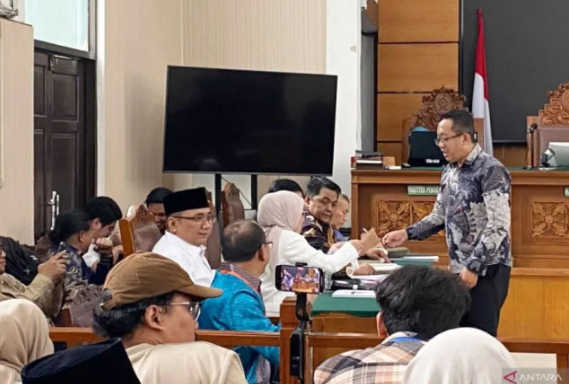
The proceedings of the pretrial request filed by former Minister of Religious Affairs, Yaqut Cholil Qoumas, featured a number of expert testimonies from both the applicant’s side (Yaqut) and the respondent (the KPK).
In the trial held at the South Jakarta District Court, the experts outlined legal opinions related to the procedures for naming a suspect, calculation of state losses, and the administrative authority in the 2023-2024 hajj quota case.
Here are the main points from the expert testimony in the proceedings:
Criminal law expert for Yaqut, Mahrus Ali, argued that the investigative audit into state financial losses should have been completed before a suspect was designated.
“First, substantive delict. Second, delict of material omission. Third, a delict that is qualified by its consequences. These three types of delicts, they must prove a causal link—in other words, there must be an effect. In the context of this article, there must be a consequence in the form of state financial losses calculated by a state body that, according to the results of the investigative audit, the losses have arisen. And that must have existed before a person is designated as a suspect, not afterwards,” said Mahrus in the hearing, Thursday (5/3).
Meanwhile, Erdianto, a criminal law expert brought by the KPK, explained that the application of Section 2 and Section 3 of the Corruption Crime Act (UU Tipikor) after the Constitutional Court ruling can be applied if there is a result of an audit calculating state losses.
“A potential loss that merely arises could be deemed a completed crime under Articles 2 and 3 of the old UU Tipikor. The mere potential loss would have already constituted the crime. But then with the MK (Constitutional Court) ruling, it shifts to a substantive delict. There must be losses to the state first,” he said in the hearing, Friday (6/3).
Yaqut’s side also brought in a constitutional law expert, Oce Madril, to the pretrial hearing. In the proceedings, Oce assessed that the designation of Yaqut as a suspect by the KPK was legally flawed.
This assessment was conveyed by Oce at Yaqut’s pretrial hearing held at the South Jakarta District Court on Thursday, 5 March. He stressed that the designation of Yaqut as a suspect was legally flawed because the designation letter was signed by the KPK leadership.
“This letter (the Yaqut suspect designation) is quite simple. If this letter had been signed by the investigator, the issue of authority would be settled. But because this letter uses a model, this—my assumption is the older model, perhaps the old KPK Law worked this way. But it seems that if the administration does not change, if it is like this, then the KPK leadership cannot delegate because they do not have the authority. Well, with a model like this, it is a material defect and a formal defect, the kinds of letters like this,” Oce said.
He stated that under the new KPK Law, the leadership no longer has authority as investigators.
“I think not, because as I mentioned, Article 21 of Law Number 19 of 2019, the new KPK Law, because the leadership no longer has attributive authority as investigators, therefore they have no authority to delegate. So what would be delegated? So there is nothing that can be delegated,” he said.
On the other hand, administrative law expert Emanuel Sujatmoko, presented by the KPK, explained that the position of the Minister of Religious Affairs has discretionary authority in regulating the allocation of the hajj quota.
“That means: if that is in the law, for example if there is an increase in the hajj quota, from 100 to 125, then this would be regulated in a ministerial regulation. Therefore, ministerial regulations are interpreted as statutory regulations because they are governed by higher regulations when we refer to Article 8 of Law 12 (2011).”
“Yes, I have said that the minister has the power to regulate. That’s all,” he added.
Regarding the suspect’s rights, Oce Madril emphasised the importance of delivering the suspect designation letter as regulated by Article 90 of the new KUHAP.
“Yes, I think there is no problem with ‘being notified’ or ‘being provided’, they mean the same. The point is that the document owner should deliver it to the prosecutor, basically. For what? So that the person knows. Do not keep the document. The person should be informed, as it has legal consequences, right,” Oce said.
Finally, Najmatuzzahrah when asked about the legal basis of the hajj quota as state finances, stated that there is no specific jurisprudence on this matter yet.
“If for the hajj quota specifically, perhaps there is no jurisprudence yet. But for quotas, such as oil quotas, oil import quotas, vegetable oil quotas, meat quotas, import quotas for meat, these could also be argued jurisprudentially in that direction,” she concluded.
The KPK Legal Bureau team, Indah Oktiant, stressed that their agency based its case on the BPK investigative report which found irregularities in the designation and filling of the special additional hajj quotas, as well as flows of funds in 2023 and 2024.
“With the conclusion of irregularities against the laws committed by the related parties… the irregularities resulted in state losses amounting to Rp622 billion,” said Indah.
A KPK expert witness at Yaqut Cholil Qoumas’ pretrial hearing stressed that a designation of a suspect under the UU Tipikor must be based on a concrete and certain audit of state losses.
Earlier, on 4 February 2026, the KPK carried out an arrest operation at the Directorate General of Customs and Excise (Ditjen Bea Cukai) of the Ministry of Finance.
The KPK again conducted searches of several rooms at the Pekalongan Regency Government Secretariat Office on Friday (6/3) afternoon in connection with the Pekalongan Regent Fadia Arafiq corruption case
KPK reveals the role of the Regent’s child in project intervention. See the modus operandi of PT RNB owned by Fadia Arafiq’s family in monopolising regional projects.
KPK plans to question the husband (a member of parliament) and the Regent of Pekalongan’s child regarding the Rp19 billion corruption funds and PT Raja Nusantara B