
Facts about the Bandung Earthquake on 13 March 2026 and Its Connection to the Sukabumi Epicentre
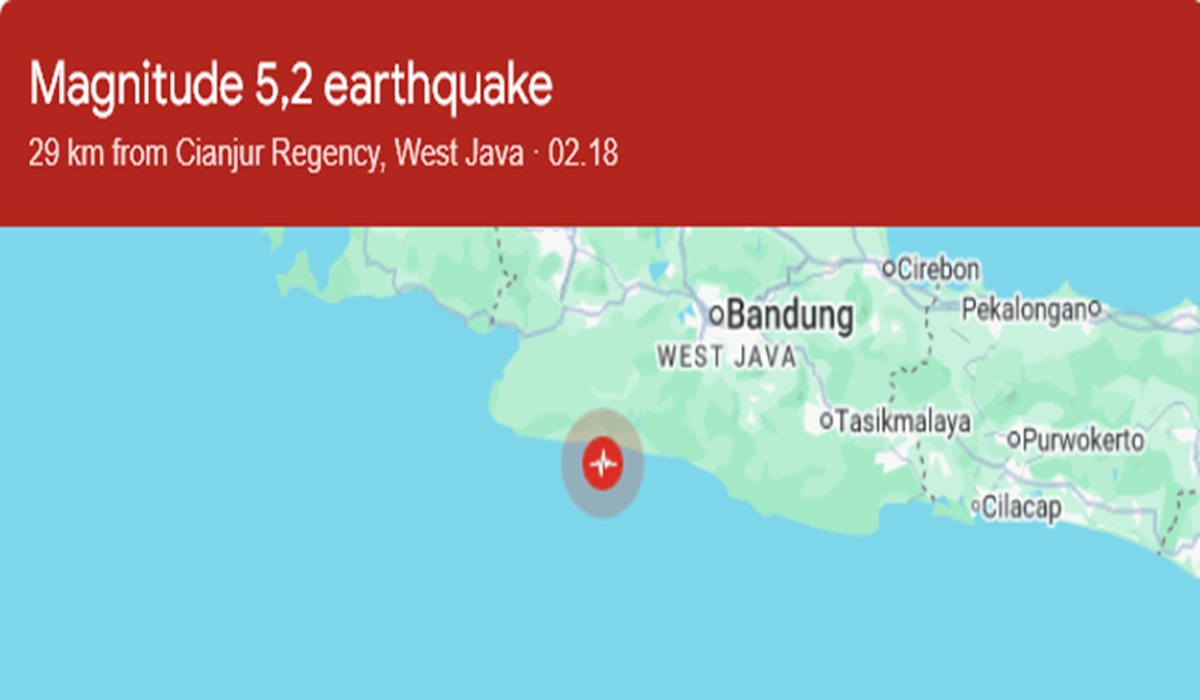
A magnitude 5.3 earthquake was reported to have struck South Java on 13 March 2026 at 02:18 Western Indonesia Time. The epicentre was not located directly beneath Bandung city but was instead related to seismic activity in the Sukabumi region.
According to data from the Indonesian Meteorological, Climatological and Geophysical Agency (BMKG), the earthquake had its epicentre at sea at coordinates 8.04 South Latitude and 106.86 East Longitude, approximately 121 kilometres south-east of Sukabumi District, with a depth of 53 kilometres. The magnitude was later revised from an initial reading of 5.4 to 5.3.
The earthquake was classified as a shallow quake triggered by the activity of the Indo-Australian Plate subducting beneath the Eurasian Plate. Source mechanism analysis indicated strike-slip movement.
Although the epicentre was located in the Sukabumi region, the seismic waves propagated widely and were felt in Bandung, Garut, and Jakarta. A common question amongst residents concerns whether the earthquake was related to the Lembang Fault. Geologically, the 13 March 2026 earthquake originated from a subduction zone at sea, whereas the Lembang Fault is an active terrestrial fault that extends 29 kilometres from Padalarang to Jatinangor. Despite their different sources, seismic activity in southern West Java remains a concern for Bandung residents regarding the potential for local faults to be triggered by regional tectonic instability.
Topographically, Bandung sits above soft sedimentary soil from an ancient lake. This type of soil has the characteristic of amplifying or strengthening seismic waves, which explains why earthquakes centred far out at sea south of Java are often felt quite strongly in urban Bandung compared to areas with hard soil structures.
The 13 March 2026 Bandung earthquake serves as a reminder of West Java’s position in an active tectonic zone. Although this magnitude 5.3 earthquake posed no tsunami risk and caused no significant damage in Bandung, individual disaster preparedness remains a key factor in ensuring safety.
The BMKG confirmed the earthquake posed no tsunami risk. The epicentre was located at sea, 121 kilometres south-east of Sukabumi District, West Java, at a depth of 53 kilometres beneath the ocean surface.