
Fact Check: Is Trump Really Panicking Over Takbir Chanting?
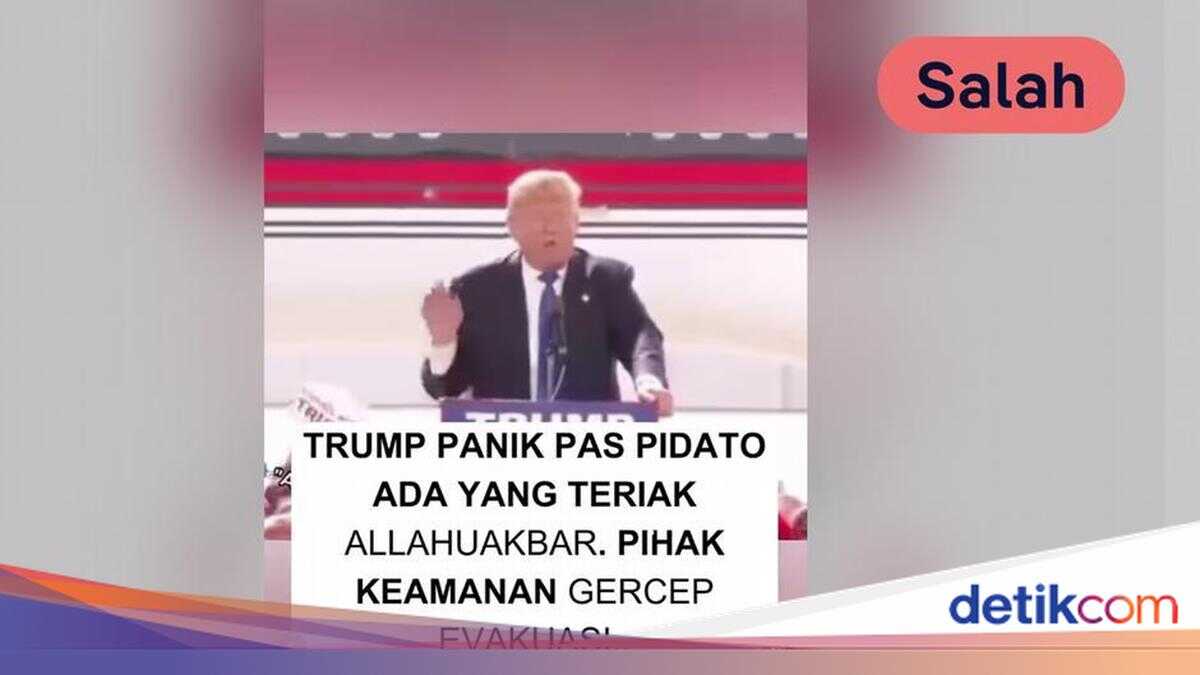
Over the past week, a video has circulated showing United States President Donald Trump turning away from a podium on stage after hearing someone shouting “Allahu Akbar”.
The text on the video states: “Trump panics during speech when someone shouts Allahuakbar. Security quickly evacuates.”
At the time this article was written, the video shared on Instagram had been viewed 4.6 million times. The video was liked by 150,000 users and commented on by five thousand accounts. Some comments believed the text written on the video.
The DW Indonesia Fact-Check team traced the authenticity of the video and the claims made in the accompanying text.
Claim: Trump panicked during a speech when someone shouted Allahu Akbar.
DW Fact-Check Result: False.
Verification steps undertaken by DW
The first step taken by the DW Indonesia Fact-Check team in verifying the authenticity of the viral video and the accuracy of the claim was to test whether the video was created using artificial intelligence (AI) technology. Analysis by the AI detection platform Hive Moderation revealed that the probability of the video being created by AI was 0 per cent. This indicated the video itself was authentic. The audio within it, however, would be discussed separately.
The verification process continued to determine the actual context of the video.
The simplest approach we took was to use keywords that best described the moment in the viral video. We selected the keyword “Trump flinch security”. The search engine returned one video showing exactly the same imagery. Trump was on stage at a podium, surrounded by crowds, and turned away mid-speech.
The video was broadcast by CBS on its YouTube account, showing a moment from Trump’s campaign rally in Ohio in mid-March 2016. The actual context of the video was that Trump turned his face away after one campaign attendee allegedly attempted to rush the stage. Security personnel immediately surrounded Trump to protect him.
To strengthen the evidence, we also conducted a search using Google Reverse Image, which led us to a fact-check report by AFP, which also contained a link to the original video with the actual context of the Trump incident.
The most important finding from the original video was that there was no “Allahu Akbar” chanting as heard in the viral video that was circulating. The AI voice detection platform Deepfake Total analysed the audio. The result showed that the probability of the audio being artificially created was low, at approximately 25 per cent, suggesting that the creator deliberately added the audio for a particular purpose.
Hoaxes amid various sentiments
When searched using the keyword “Trump Allahuakbar”, search engines show that the hoax video was previously uploaded nine years ago on Facebook. At that time, several news channels had published that the video was a hoax. Nevertheless, in 2025, the same video reappeared and became a topic of discussion on social media. The video was not only spread from Indonesia but also from the Middle East. Most recently, in late February 2026, the same video went viral on social media again.
The hoax about Trump resurfaced amid widespread discussion about the results of President Prabowo Subianto’s meeting with Trump during the inaugural Board of Peace meeting in the United States on 19 February 2026.
Co-founder and Fact-check Analyst at Mafindo, Aribowo Sasmito, stated that the hoax about Trump “rides on issues that are currently trending.” One reason for this is to draw public attention on social media. “If discussions about Trump become popular again in the future, this hoax could be brought up again,” Aribowo said in a telephone interview with DW Indonesia. He also estimated that the hoax spreaders have several motives, namely seeking popularity and financial gain.
Meanwhile, Lead Analyst at Drone Emprit, Rizal Nova Mujahid, stated that the trend of republishing content containing disinformation, slander, and hatred (DFK) is now also being carried out by homeless media accounts such as the account that uploaded the viral video.
“I have only recently seen this model and hoaxes are usually spread to only one particular social group,” Rizal said in a video interview with DW Indonesia.
“If you look at it, using the word Allahu Akbar, it certainly would not be accepted by those who are not chanting Allahu Akbar, nor by those who are sufficiently critical,” he added. He believed that the level of digital literacy greatly influences a person’s trust in content.
Rizal assessed that negative public sentiment towards Trump, the Board of Peace, and trade agreements between Indonesia and the United States contributed to the emergence of disinformation. Rizal’s analysis also noted that religious sentiment played a role in the emergence of the viral hoax video related to Trump.
“When discussing Gaza, religious sentiment is always higher than humanitarian sentiment. It is therefore quite understandable that some people would try to incorporate their disagreement with Indonesia’s decision at the Board of Peace and then produce narratives like this,” said Rizal.
The pause that is needed
“Seeing is not only believing. Especially in this age of artificial intelligence,” said Aribowo. According to him, a person could become increasingly vulnerable to trusting videos created with advanced artificial intelligence techniques. Therefore, Aribowo advised social media users to check the credibility of information sources whenever consuming content on social media. “If the source is not a credible mass media outlet or one with a good reputation, we must be sceptical,” said Aribowo.
There are several simple ways that, according to Rizal, can be done to examine whether content is a hoax or not. “Most importantly, pause first. Thumb should be held back from amplifying, liking, or commenting. Then verify,” said Rizal. Verification needs to be done against the narrative, the actors in the video, and the timing. “Because to observe and check…”