
Facing Middle East Impact, Airlangga Proposes This Solution at ASEAN Meeting
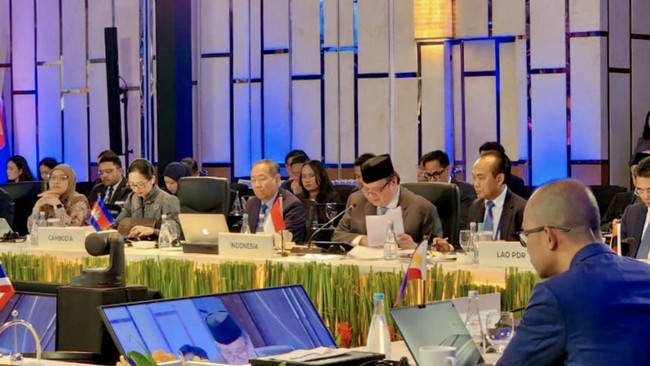
The 27th ASEAN Economic Community Council (AECC) meeting was held at Dusit Thani in Cebu, Philippines, on Thursday (7/5/2026), focusing on the impact of the Iran-US and Israel conflict.
This conflict has caused successive effects, from energy supply limitations to surges in commodity and food prices across the ASEAN region. For the first time since the pandemic, ASEAN’s economic performance faces the risk of slowdown due to this global conflict.
Coordinating Minister for the Economy Airlangga Hartarto views the need for concrete steps and strengthened regional resilience to withstand and address disruptions from the effects of war and global conflicts.
“To address disruptions, energy resilience is required, optimisation of existing cooperation platforms, and a focus on strengthening trade among ASEAN members with strategic partners, such as ASEAN Plus One FTAs and the Regional Comprehensive Economic Partnership (RCEP), as well as utilising energy resilience cooperation like the ASEAN Power Grid (APG) and ASEAN Framework Agreement on Petroleum Security (APSA). In addition, leveraging ASEAN centrality is necessary to build supply chain resilience in the region,” stated Coordinating Minister Airlangga.
Airlangga also emphasised the need for ASEAN to undertake various efforts in facing global trade dynamics by promoting strengthened regional cooperation, particularly in the energy, food, and supply chain sectors, to maintain economic stability in the region.
Representing Indonesia, he also pushed for concrete steps to strengthen regional energy resilience, including through diversification of sources and supply routes, strengthening energy reserve mechanisms, and accelerating the implementation of regional cooperation. Diversifying trading partners by utilising existing FTA networks and cooperation, while still focusing on increasing intra-ASEAN trade as the top priority.
Several institutions also provided views and input regarding the risks of the Iran conflict and its impact on ASEAN.
AMRO’s Chief Economist, Dong He, also outlined risks from US domestic policies causing energy and pesticide supply disruptions to the region, leading to rises in energy and transportation prices, as well as currency depreciation. These increases are triggering inflation surges in the ASEAN region to the highest levels since the pandemic.
AMRO indicates that ASEAN faces stagflationary pressures or the strongest stagnant economic growth since 2011. For this reason, AMRO suggests policies to address volatility in the short term and build resilience in the long term in a pragmatic and adaptable manner.
The ADB, also invited as a speaker at this meeting, provided policy proposals for stability to address the surge in war impacts that could disrupt ASEAN’s economic performance.
For this, the ADB proposes energy and food resilience through concrete programmes with ASEAN bodies and the ASEAN private sector. In addition, as a major development bank partner and investment consultant, the ADB is ready to inject financing into ASEAN stock markets to withstand volatility and pressures.
The ASEAN Secretariat proposes ASEAN CORE (Coordinated Response for Enduring Resilience) as an immediate response for regional resilience, which includes strengthening and reforming institutions, deepening financial and economic integration, enhancing energy, food, and societal resilience, and improving maritime supply chain resilience.