
Facing Godzilla El Niño, Amran Accelerates Pompanisation - Funds Prepared to This Amount
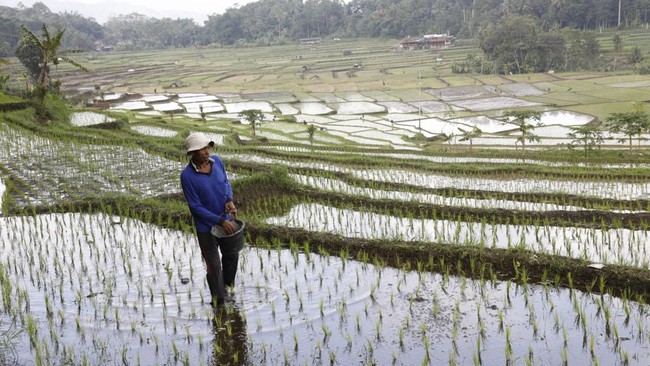
Jakarta, CNBC Indonesia - Agriculture Minister Amran Sulaiman has revealed that the government has prepared a substantial budget for the pompanisation programme as the primary measure to address the threat of extreme El Niño, which he terms ‘El Niño Godzilla’. The budget allocated for this programme amounts to trillions of rupiah.
“(The pompanisation budget) is approximately Rp3-4 trillion, and we are also repairing irrigation together with the Minister of Public Works,” Amran said when met after a meeting at the Parliamentary Complex, Jakarta, on Tuesday (7/4/2026).
The budget is being used for the procurement and mass distribution of water pumps to various regions in Indonesia. Amran stated that a total of 80,000 units of pumps have been distributed to ensure water supply remains available for agricultural lands during the dry season.
“Alhamdulillah, through our pompanisation, we have distributed approximately 80,000 pumps across Indonesia,” he said.
In addition, the government is ensuring that farmers are not burdened with additional costs for using the pumps, including initial operational expenses.
“We are providing the pumps for free,” he emphasised.
This pompanisation initiative forms part of the government’s broader strategy to strengthen national food security in the face of potential production declines due to El Niño. Besides pumps, the government is also carrying out land optimisation (oplah) by improving irrigation systems in extensive swamp areas.
“Then oplah, which is the optimisation of swamp lands where we are repairing irrigation for 800,000 hectares across Indonesia,” he said.
Amran assured that with these various interventions, the national food situation is in a relatively safe position even if El Niño occurs. He explained that current national food stocks and future production projections are still sufficient to meet domestic needs.
“So our preparations are much better. Then our stocks this month, Insha’Allah, reach 5 million tonnes. Stocks in homes, hotels, and restaurants are 12.5 million tonnes, and our standing crop is 11 million tonnes,” he elaborated.
He explained that the standing crop, or unharvested plants, currently equates to 11 million tonnes. When added to other stocks, the national food reserves total around 28 million tonnes.
“What is meant by standing crop is the current unharvested crops valued at 11 million tonnes equivalent. In total, 28 million tonnes; if we divide by 2.6 million tonnes (monthly needs of the Indonesian population), that (stock is enough for) 10.7 months or approximately 10-11 months until January,” he continued.
Assuming production continues even during El Niño, Amran is optimistic that Indonesia can maintain its food supply.
“And remember, if El Niño occurs, our production is still 2 million tonnes per month. El Niño is estimated to last 6 months, while our preparations cover 10-11 months. That means it’s safe,” he stated.
Bapanas Ensures Food Stocks Are Safe
Meanwhile, Deputy for Food Availability and Stabilisation at the National Food Agency (Bapanas), I Gusti Ketut Astawa, stated that the public need not worry about national food availability, as current stock and production levels are very sufficient amid potential climate disruptions.
“As conveyed by the Head of the National Food Agency (Amran Sulaiman, who also serves as Agriculture Minister), our food stocks are relatively very good. If we look at the 2025 carry-over stock, it was also good at around 12.4 million tonnes. Then production from January to March was also good. That means for the future, from a stock perspective, it’s relatively very safe,” Ketut said in his statement on Tuesday (7/4/2026).
Based on data as of 7 April 2026, the Government Food Reserves (CPP) are in a strong condition, particularly for strategic commodities. Rice stocks are recorded at around 4.6 million tonnes, equivalent to 175 per cent of the national monthly needs, providing adequate room to maintain supply continuity and price stability. Meanwhile, availability of other commodities such as corn at 177,000 tonnes, consumer sugar at 48,000 tonnes, and cooking oil at 120,000 kilolitres is also deemed sufficient to meet public needs.
Amid the maintained reserves, the government continues to monitor various potential risks that could affect food supply. Climate developments, including the potential for El Niño, are a concern, so anticipatory measures are continuously prepared to keep food availability stable.
“Anticipatory steps are being prepared meticulously. The Minister of Agriculture, who is also the Head of Bapanas, has instructed accelerated planting during the rainy season, ensuring fertiliser distribution, preparing mechanisation, and strengthening coordination. With this readiness, it is hoped that production will remain maintained if El Niño occurs,” Ketut said.
Ketut urged that various circulating forecasts be responded to wisely. The public should not engage in excessive buying because food stocks are safe.
“We remain vigilant against various possibilities, including El Niño. However, we also convey to the public that with sufficient stock conditions and anticipatory steps already prepared, the public need not panic, which could lead to panic buying,” he emphasised.