
Experts Warn of Threats Beneath Kalimantan: Old Fault Reactivation Detected
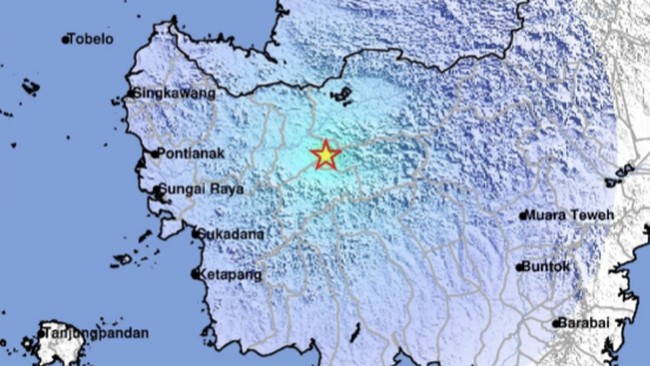
Jakarta — A magnitude 5.0 earthquake that struck the Kayan Hilir region of Sintang, West Kalimantan, on Friday, 13 March 2026 at 03:04 WIB has prompted warnings from geological experts. The tremor was felt across Sintang, Sanggau, Katingan, Melawi and several other areas in West and Central Kalimantan.
The earthquake further contradicts the assumption that Kalimantan is nearly free from seismic activity. Prior seismic events recorded in the region include a magnitude 4.8 earthquake on 23 January 2026, a magnitude 3.0 on 22 February 2020, and a magnitude 3.1 on 27 March 2019.
This demonstrates that Kalimantan is not immune to tectonic activity. Consequently, experts urge that amidst accelerating development in Kalimantan, understanding local earthquake sources is essential.
“Kalimantan has long been perceived as a region almost free from earthquakes,” explained Daryono, a member of the National Earthquake Study Centre (PUSGEN), in a statement issued on Monday, 16 March 2026. “Compared to other Indonesian regions such as Sumatra, Java, and Sulawesi, which lie near active subduction zones and megathrust boundaries, seismic activity in Kalimantan is indeed far lower. However, low earthquake frequency does not mean this region is entirely sterile from tectonic activity.”
“Whilst the probability of major earthquakes is low, a precautionary approach remains necessary because shallow crustal earthquakes can cause significant impacts if they occur near populated areas or vital facilities. Modern infrastructure, industrial zones, and developing cities in Kalimantan still require risk-based mitigation approaches,” Daryono emphasised.
Daryono identified the Adang Fault as a key local earthquake source in Kalimantan that warrants attention. This fault is suspected to have triggered Friday’s earthquake.
“The Adang Fault is a regional fault structure extending across Kalimantan from the eastern coast to the north-western part of the island. The continuation of the Adang Fault is located in the Lupar area, which forms the border between West Kalimantan and Sarawak near the city of Kuching,” Daryono explained.
“The Adang Fault is generally interpreted as an old fault that developed since the Tertiary period, rather than a Quaternary fault that is highly active like many faults in Java or Sumatra,” he added.
The expert, who also serves as Vice Chairman of the Indonesian Disaster Experts Association (IABI), described how the fault line likely originates from the Adang Gulf area near Paser District in East Kalimantan. “From there, the fault line is believed to continue inland towards the Sintang, Sekadau, and Sanggau areas. The fault then extends towards the border region near Entikong and connects with the geological structure system in the Kuching area of Sarawak,” he stated.
According to Daryono, two interpretations exist regarding the Adang Fault. The first proposes that the Adang Fault comprises a continuous, uninterrupted fault line extending from the South China Sea to Sulawesi. The second theory suggests that the Adang Fault in East Kalimantan does not connect with the Lupar Line in West Kalimantan, as there is no supporting field evidence or remote sensing data to establish an Adang-Lupar connection.
Regarding earthquake characteristics from the Adang Fault, Daryono explained that earthquakes from local faults such as the Adang Fault typically differ from subduction zone megathrust earthquakes.
“Magnitudes tend to be smaller but occur at shallow depths, meaning local shaking potential can be relatively significant. The Friday earthquake, for example, was strong enough to wake residents and send them fleeing from their homes. In this context, earthquake threats in Kalimantan are more local and sporadic in nature, rather than the frequent major earthquakes common in western Indonesia,” he noted.
Despite not being as active as major faults elsewhere in Indonesia, Daryono emphasised that the Adang Fault’s presence is reflected in the small to moderate earthquakes that periodically occur in Kalimantan.
“Several local earthquakes recorded in West Kalimantan, particularly around Sintang and Sekadau, are often associated with this fault activity. These earthquakes typically have small to moderate magnitudes, but because they originate from shallow crustal sources, vibrations from these shallow crustal earthquakes can feel quite strong in areas surrounding the epicentre,” he stated.
“Thus, the Adang Fault serves as a reminder that Kalimantan’s tectonic stability is relative, not absolute. Its seismic activity is indeed infrequent and generally minor, but its presence demonstrates that Earth’s dynamic processes continue beneath an island long considered the most stable in Indonesia. Awareness of this local earthquake potential is crucial in building a Kalimantan that is safe and resilient to disasters,” Daryono asserted.
Daryono further explained that Kalimantan’s low earthquake activity is partly due to its location within the interior of the Sunda Platform, far from active plate boundaries. “Unlike Sumatra and Java, which are directly affected by the collision between the Indo-Australian and Eurasian plates, Kalimantan lies within relatively stable crust. Consequently, tectonic deformation is weaker and less likely to trigger major earthquakes,” he noted.
“However, ancient fault structures such as the Adang Fault can still undergo reactivation due to regional stresses acting on the crust,” Daryono concluded.