
Experts Reveal Potential Emergence of Muria Strait After 300 Years of Absence
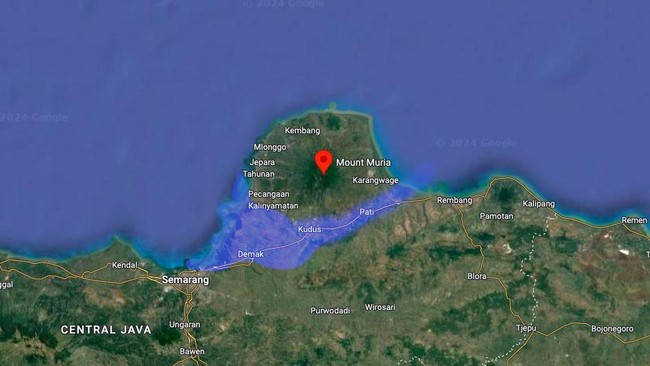
The coastal regions of Central Java, specifically Demak, Kudus, and Pati, experienced flooding in 2024, which sparked speculation about the potential re-emergence of the Muria Strait that had disappeared over 300 years ago.
Historically, the Muria Strait separated Java Island and Mount Muria. However, over time, the strait dried up and became land.
In 2024, the National Research and Innovation Agency (BRIN) addressed the widespread speculation surrounding the potential re-emergence of the Muria Strait. Eko Soebowo, a geology expert at BRIN, noted that land subsidence in the region occurs readily.
The Muria Strait could potentially re-emerge, but the cause would not be the flooding that occurred in Central Java’s coastal regions.
“The material is prone to subsidence when there is a load. It remains vulnerable. Cities like Semarang and the coastal areas experience subsidence because the underground material has not undergone complete compaction,” Eko explained.
Eko detailed that land subsidence in the Semarang, Demak, and surrounding areas varies, with the highest intensity reaching 10 centimetres per year, as observed in eastern Semarang.
These variations depend on the typical soil characteristics of each region and the supporting factors for land subsidence in those areas.
Land subsidence factors are divided into two categories: natural factors and anthropogenic factors, or impacts from human activity.
Natural factors include the characteristics of young sedimentary soil, which inevitably experiences land subsidence. This factor typically causes subsidence of around 1 centimetre per year.
Additionally, the second natural factor is tectonic activity. This factor has limited impact, causing subsidence of only a few millimetres.
Meanwhile, anthropogenic or human-induced factors are the largest contributor. Infrastructure loads on soft soil can cause subsidence of 1 centimetre per year.
Furthermore, groundwater extraction is the dominant factor, potentially causing subsidence of up to 7 to 8 centimetres per year.
Besides land subsidence, Eko noted that rising sea levels due to climate change could also contribute to the potential re-emergence of the Muria Strait.
Flooding is Not the Cause of the Muria Strait’s Re-emergence
Eko emphasised that flooding is not a factor causing the Muria Strait’s return. He stated that flooding would actually raise the land level.
“Regarding flooding, it actually fills the sedimentation in the strait area. From Mount Muria, from south Demak, south Semarang, all the rivers flow into the coastal areas,” Eko explained.
“They carry material, causing sedimentation. However, flooding is not what causes the strait to re-emerge,” he continued.
Additionally, flooding carries sediment to affected areas, resulting in increased elevation of the land.