
Expert warns DIY entering final 30 years of megathrust cycle
Jakarta (ANTARA) - Indonesian disaster experts are reminding the government and people of the Special Region of Yogyakarta (DIY) to prepare for the potential of a megathrust earthquake, which is predicted to have a 200-year recurrence cycle and is now in its final 30-year phase.
Chair of the Advisory Board of the Indonesian Association of Disaster Experts (IABI) Prof Dwikorita Karnawati stated that the southern Java region, including Yogyakarta, is currently in the final 30 years of that major cycle, according to studies by experts from Bandung Institute of Technology (ITB) or ITB University.
“This is not to frighten, but the result of scientific studies to support policy. We are at the end of the 200-year cycle where the energy has not yet been released. The potential magnitude could reach 8.7, so preparedness in DIY must be seriously enhanced,” she said during a seminar commemorating the 20th anniversary of the Yogyakarta Earthquake, attended from Jakarta on Thursday.
Dwikorita, who is also a former head of the Meteorology, Climatology, and Geophysics Agency (BMKG), emphasised the importance of building adaptive infrastructure, as has been implemented at Yogyakarta International Airport (YIA), to minimise the risk of fatalities when that megathrust energy is released.
The building is designed to remain sturdy and capable of serving as a temporary evacuation site for around 12,000 people on the mezzanine floor and terminal.
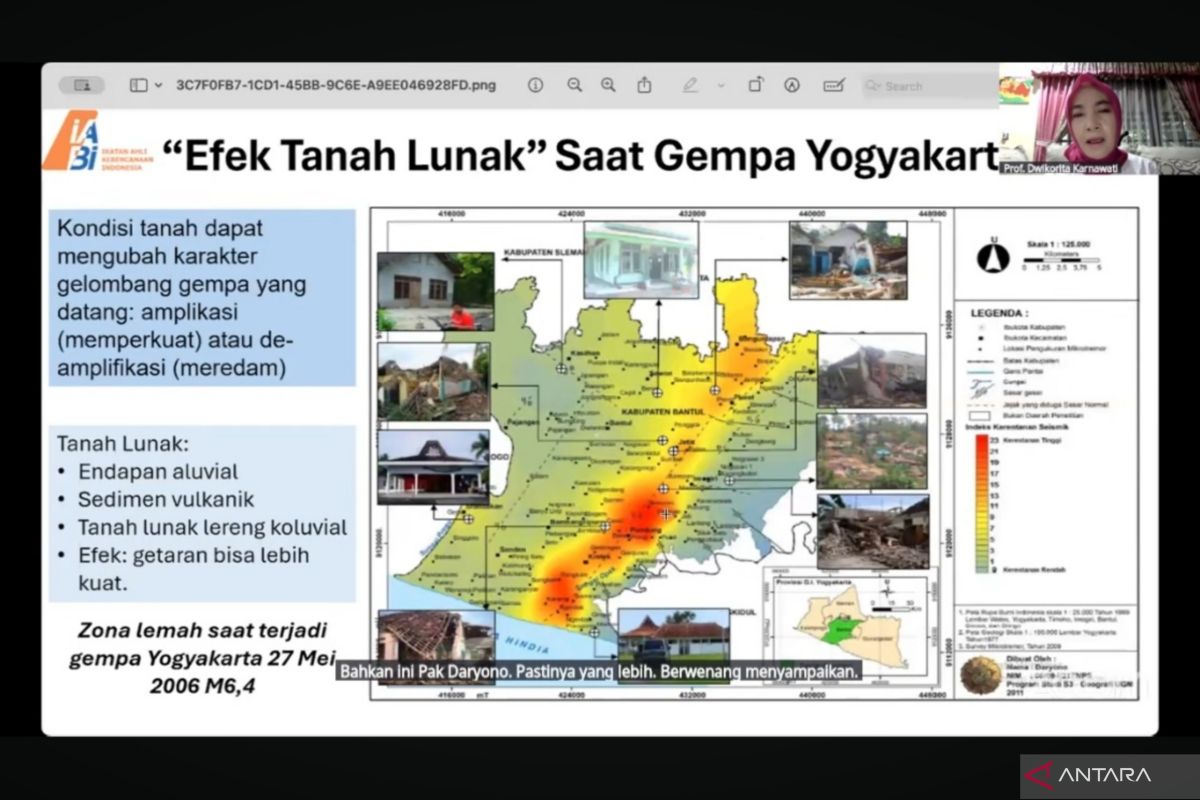
In addition to the megathrust threat along the southern coast, she also highlighted the complexity of the Opak Fault, which triggered the 2006 inland earthquake.
According to her, recent studies show that the fault is not a single break, but a complex fault system that branches out as it approaches the earth’s surface.
“The Opak Fault does not cut the surface, so it is called a blind fault. However, its movement mechanism is very dynamic, and its energy has not been fully released since the 2006 event. This demands stricter spatial planning, especially in zones with high ground shaking amplification,” she said.
In the seminar, she openly appreciated the consistency of leadership in DIY that trusts science-based policy recommendations.
As such, she hopes that the synergy between early warning technology and local wisdom will continue to be maintained to ensure ongoing preparedness, considering major disaster cycles in the future as something that must be mitigated from the outset.