
Expert: Train Track Magnetic Fields Cannot Disrupt Car Electrical Systems
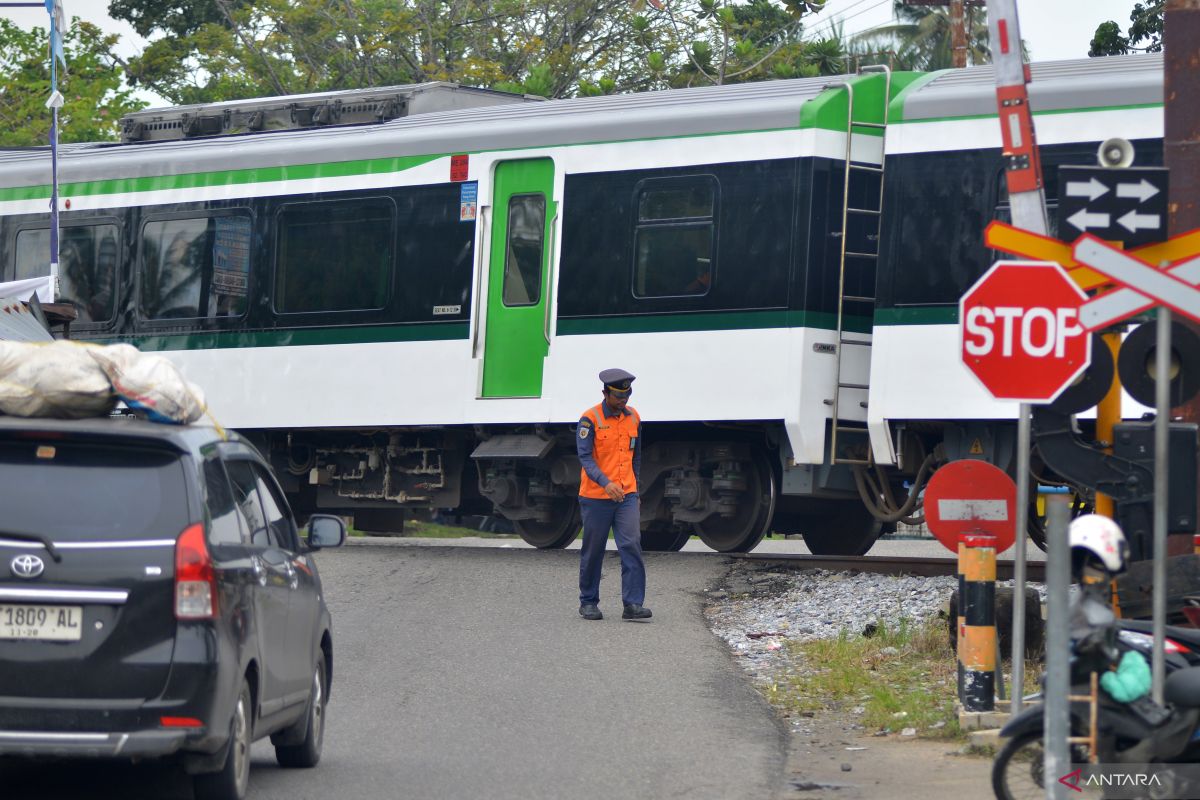
Jakarta (ANTARA) - Automotive expert from the Bandung Institute of Technology, Yannes Martinus Pasaribu, stated that the magnetic fields around train tracks are scientifically incapable of disrupting the electrical systems of modern cars and causing them to stall suddenly while crossing level crossings.
“Scientifically, the magnetic fields produced by train tracks are entirely unable to interfere with or damage the ECU (Electronic Control Unit) or other electrical components in modern ICE (Internal Combustion Engine) vehicles,” he said when contacted from Jakarta on Monday.
He explained that the strength of the magnetic fields around the tracks ranges from 0.5 to 5 microTesla (µT), far weaker than the Earth’s natural magnetic field, which reaches 25–65 µT.
This means, he continued, that everyday vehicles are already exposed to much stronger magnetic fields without any disruption.
Yannes also noted that the frequency of the magnetic fields from the tracks is very low, below 50 Hz, so they do not have sufficient energy to induce significant electrical currents in the vehicle’s electronic systems.
“Another fact is that all electronic components in modern vehicles sold to the public must pass EMC international standards tests, such as ISO 11452, which requires resistance to electromagnetic radiation interference up to hundreds of V/m (volts per metre), while exposure from track fields is equivalent to less than 0.01 V/m,” he explained.
Additionally, he said, the metal body of the car naturally acts as an electromagnetic shield (Faraday Cage), capable of attenuating external radiation by 40–60 dB.
Such conditions, according to him, reduce the magnetic fields from the tracks by 100 to 1,000 times before they reach the car’s ECU.
“Thus, there is no physical or technical mechanism that allows train track magnetic fields to cause a car to stop or stall,” he said.
For cars with manual transmissions, he noted, the common issue arises from the uneven condition of the crossing or protruding rails creating physical obstacles for passing vehicles.
In such conditions, a vehicle that has slowed down may lose momentum.
If the driver uses too high a gear at low speed, the engine rotation may drop below the minimum limit, causing the engine to cut out suddenly.
“If the driver does not immediately downshift or fails to operate the clutch correctly, and this likelihood increases dramatically when panic narrows cognitive focus, the engine cuts out right on the tracks,” said Yannes.
He stated that issues related to level crossing infrastructure also increase the risk of traffic accidents.
“Contributing factors that worsen both scenarios are inadequate crossing infrastructure, crossings without official barriers, without vehicle detection systems, and the presence of level crossings on busy routes that should have been replaced with underpasses,” he explained.
“Technically, EVs have a very low potential for sudden engine cut-outs when crossing train tracks, because the electromagnetic fields produced by the tracks are too weak to affect the vehicle’s electrical systems, whether EVs or conventional fuel vehicles,” he explained.
According to him, modern electric cars are designed with electromagnetic interference protection and must pass a series of compatibility tests before being marketed.
Electric vehicles, among others, must meet ISO 11451 and ISO 11452 standards to ensure the vehicle’s and its components’ resilience to electromagnetic field exposure, as well as ISO 7637 to test electrical disturbances in high-voltage systems.
Additionally, Yannes said, electric cars must comply with regulations on radiation emissions and vehicle electromagnetic compatibility.