
Expert: Community-Based Approach Essential to Reduce Accidents at Railway Crossings
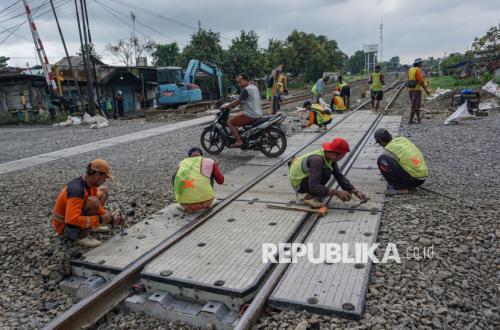
The Chairman of Advocacy and Community Affairs for the Indonesian Transportation Society, Djoko Setijawarno, assesses that the high number of accidents at railway crossings requires a shift to a more comprehensive, community-based handling approach.
In the last two years, accidents at illegal crossings have remained high. Data shows that from 2024 to 2025, there were 668 accidents with 327 fatalities. Even this year alone, 38 incidents have been recorded with 39 deaths.
This issue was discussed at a focused group discussion (FGD) forum organised by LKBN ANTARA with various stakeholders in Jakarta on Wednesday (15/4/2026).
Djoko explains that improving safety at railway crossings needs to be carried out through three main pillars: education, engineering, and enforcement. He stresses that changing public behaviour is the key factor in sustainably reducing accident rates.
“Changing public behaviour is the main key to sustainably reducing accident rates,” he said.
From a social perspective, sociologist from the University of Indonesia, Erna Karim, views the existence of illegal crossings not merely as a technical issue. This phenomenon reflects the real needs of the community that have not been fully accommodated in policies.
She emphasises the importance of governance changes involving various parties. “Solutions must be built through collaboration between government, operators, and the community, supported by data-based education, monitoring, and ongoing evaluation,” said Erna.
Meanwhile, the Director of Safety and Security at PT Kereta Api Indonesia (Persero), Dadan Rudiansyah, asserts that the community needs to be actively involved in safety improvement efforts.
According to him, the community cannot be positioned merely as objects of policy but must be part of the solution through understanding rules and consistent behavioural changes. “The community cannot be positioned merely as objects of policy, but must be part of the solution,” he said.
A community-based approach is considered key to bridging the gap between policies and field practices. Besides infrastructure and regulations, the level of awareness and public participation become important factors in creating a safer crossing system.
Therefore, strong synergy is needed between government, operators, and the community to reduce accident rates while realising a more orderly and sustainable transportation system.