
Evaluation Results of National Internship Programme Batch I Uncover Violations
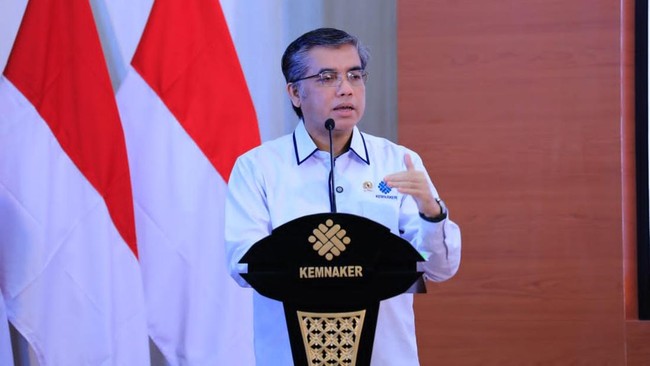
Jakarta, CNBC Indonesia - The Ministry of Manpower (Kemnaker) has officially closed the National Internship Programme Batch I, which was attended by 16,112 participants during the period from October 2025 to April 2026. The programme closure took place as of Friday (24/4/2026).
Minister of Manpower Yassierli stated that the internship programme is part of the strategy to strengthen national workforce competencies, providing not only work experience but also building skill-based work readiness.
In line with that, after completing the programme, participants will proceed to the competency certification stage as recognition of the skills acquired in the work environment.
“We invite the young participants to make the most of this opportunity because competency certification is provided free of charge as recognition of the skills they possess,” Yassierli said, quoted from a press release on Saturday (25/4/2026).
He also urged participants to prepare themselves by studying before taking the competency test at Kemnaker’s training centres or at Professional Certification Institutions (LSP) partnered with the National Professional Certification Agency (BNSP).
Furthermore, Yassierli conveyed the results of the evaluation of the National Internship Programme Batch I implementation. From the evaluation results, Kemnaker emphasised the importance of equitable programme implementation so that it is not concentrated on Java Island, but more evenly distributed throughout Indonesia to broaden opportunities for local youth.
In addition to regional equity, the programme will also be expanded to be open to all study programmes, not limited to certain majors.
In an effort to improve the quality of implementation, Kemnaker is also reviewing the strengthening of company involvement, including more structured contribution schemes to support participant mentoring.
According to Yassierli, several companies have demonstrated good practices in internships through the provision of work projects, periodic evaluations, and direct mentoring, which will continue to be strengthened in broader partnership schemes.
“This year, the focus is on providing work experience. In the future, we want not only work experience, but also to ensure that participants have competency certificates and greater opportunities to be absorbed by industry,” he said.
As a follow-up to this strengthening, Yassierli stated that Kemnaker continues to bolster the workforce ecosystem through the development of the SiapKerja platform, including the KarirHub feature that provides job vacancy information from various sectors.
Through this platform, he encouraged participants to utilise KarirHub as a means to seek employment opportunities, while also inviting companies to be more active in opening vacancies to widen access to work.
“We continue to integrate SiapKerja with private portals so that all job vacancies, both domestic and international, can be consolidated in one platform,” he said.
Nevertheless, Yassierli had previously mentioned instances of misconduct by companies towards national internship participants.
According to Yassierli, these misconducts were identified based on direct reports from the national internship participants as well as the public.
“We manage this with thousands of companies, so we create a system, we establish the mechanism for complaints from internship participants, complaints from the public, and we follow them up,” Yassierli said at the Office of the Coordinating Ministry for the Economy, Jakarta, on Thursday (23/4/2026).
Yassierli did not disclose the list of companies that committed the misconduct. However, he affirmed that the Ministry of Manpower has taken action by adding the offending companies to a blacklist for future national internship placements.
“There are quite a few companies that we have reprimanded, then blacklisted, we have saved the interns, relocated them, and so on. Of course, that is one of the mechanisms,” he explained.
He also assured that in the future, the Ministry of Manpower will establish stricter mechanisms to monitor companies that serve as placement sites for national internship participants.
“In that sense, we also look at how in the future these internship companies must have responsibility and ownership,” Yassierli emphasised.
According to Yassierli, the misconduct by companies towards national internship participants includes working hours exceeding the limits. There are also deviations in the tasks assigned, such as those not matching the participants’ field of study.
“For example, working hours. Even though we said they are not workers. The second is related to the scope; initially, it was said that when we selected, oh, this company indeed needs it because it matches the competencies of an S1 graduate. It turns out the work is more like a receptionist, and so on,” he explained.