
Estimation of 8.9 Million kg CO₂e Emissions from Customer Journeys During 2026 Eid Transport, Long-Distance Trains More Efficient Than Private Vehicles
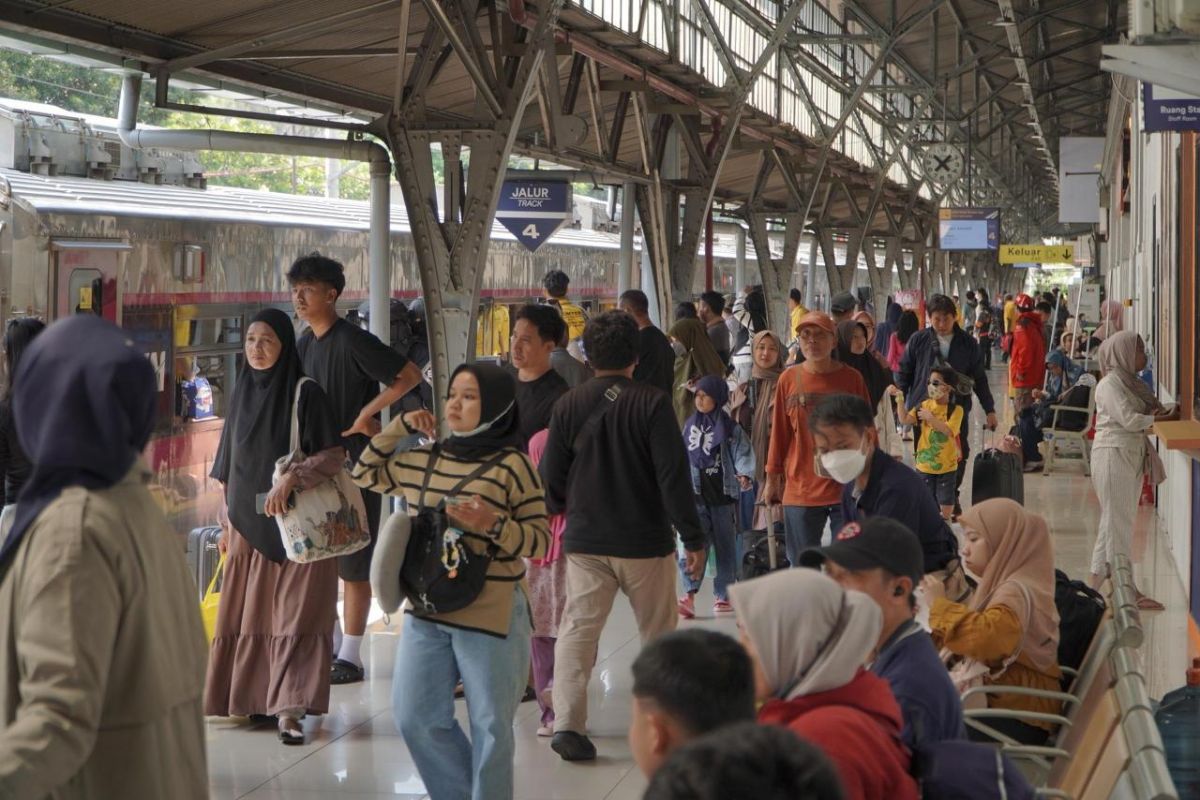
Substitution of journeys to rail contributes significantly to national carbon emission control. Jakarta (ANTARA) - PT Kereta Api Indonesia (Persero) records that every customer journey during the 2026 Eid transport period has a positive environmental impact. Based on estimates for the period from 11 March to 1 April 2026, the total emissions from Long-Distance Train services amounted to 8,928,821 kg CO₂e. Vice President of Corporate Communication at KAI, Anne Purba, stated that this figure reflects the collective contribution of customers in choosing a mode of transport with lower emission intensity. “Every customer who chooses the train plays a role in curbing carbon emissions. On the scale of millions of journeys, this choice has a significant impact on the environment,” said Anne. In comparison, if those customer journeys were made using private vehicles, the estimated emissions would be much higher. For vehicles with a 1000 cc engine capacity, the total emissions would reach 20,590,136 kg CO₂e, while 2000 cc vehicles would produce 32,575,210 kg CO₂e, and 3000 cc vehicles would reach 41,588,851 kg CO₂e. This comparison shows that customer journeys using trains result in far lower emissions than private vehicles, while strengthening the role of mass transportation in controlling environmental impacts. During the 2026 Eid transport period, KAI served 4,246,274 long-distance train customers with an occupancy rate of 118.9% of the total capacity of 3,571,760 seats. This high mobility reflects customer trust in trains as an efficient and more environmentally friendly travel option. Anne added that the environmental impact of customer journeys can now be viewed more transparently through the Carbon Footprint feature on the Access by KAI app. “Through this feature, customers can see the estimated emissions from the journeys they take. This is part of efforts to build awareness that every journey has an impact, and trains offer a choice with lower emissions,” she explained. As an illustration, a journey by train on the Surabaya Gubeng–Ketapang route produces about 2.94 kg CO₂e, while the same journey by private car reaches about 8.79 kg CO₂e. In addition to providing emission data transparency, KAI is also developing various operational initiatives that support customers’ sustainable lifestyles, such as providing water stations at stations to reduce the use of single-use plastic bottles, using face recognition for boarding to cut down on paper tickets, and employing eco-friendly dining utensils on train services. “We thank customers for their trust in choosing trains during the 2026 Eid transport period. Every journey made becomes a collective contribution to curbing carbon emissions and keeping the environment sustainable,” Anne concluded.