
Essays, the New Weapon for Warmadewa University Agriculture Students to Monitor Policies and Educate the Public
The challenges facing the agricultural sector in the future are no longer limited to upstream issues such as cultivation techniques or pest attacks. In the era of information and technological disruption, agriculture students are required to possess a new “weapon” in the form of the ability to articulate ideas through essay writing to monitor food policies and educate the public.
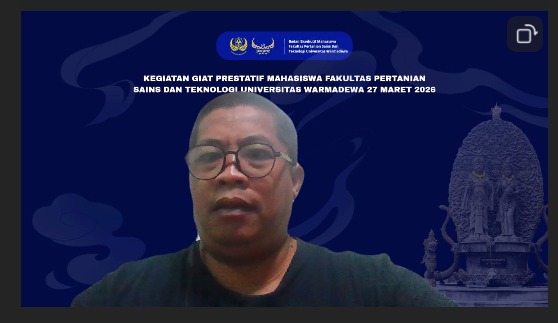
This view emerged during the Prestigious Student Activity Training at the Faculty of Agriculture, Science, and Technology (FPST), Universitas Warmadewa (Unwar), held in Denpasar on Friday (27/3). The main speaker was Dr. I Nengah Muliarta, S.Si., M.Si, an academic from the Agrotechnology Study Programme at Unwar and also the Regional Coordinator of the Indonesian Cyber Media Association (AMSI) Bali-Nusra.
In his presentation, Muliarta stressed that essays are not merely a collection of sentences in academic papers, but a navigation tool for students to remain relevant amid the flood of information and rapid technological changes. According to him, the ability to write essays forces students to conduct in-depth research, think critically, and synthesise solutions to increasingly complex agricultural problems.
“The agricultural world today faces disruptions from various sides, from climate change to market digitalisation. Without the ability to systematically express ideas through writing, brilliant student ideas will only stagnate in laboratories and fail to become solutions in society,” said Muliarta in front of dozens of FPST Unwar students.
He added that essays serve as a “weapon” due to their argumentative nature. Agriculture students who can write sharp essays will have strong bargaining power in criticising government policies or offering appropriate technology innovations that are more humane for farmers.
As someone also deeply involved in the cyber media world, Muliarta highlighted the gap between scientific findings on campus and public understanding. Agriculture students, in his view, must become science translators capable of converting technical agricultural data into digestible yet substantive narratives.
“Issues of food sovereignty or land conversion often end up as mere statistics. Students must enter the public space through essays to give life to that data. Essays are the bridge so that the public knows that agriculture is a future sector worth fighting for,” he asserted.
Furthermore, he emphasised that essay writing training is part of building intellectual character. Writing essays hones students’ analytical sharpness and social empathy towards the fate of the agrarian sector.
This Prestigious Student Activity Training is expected to ignite FPST Unwar students not only to excel technically in the field but also to be adept in idea diplomacy. With proficient literacy mastery, agriculture graduates are hoped to become opinion leaders who are not easily swept away by disruption currents but instead become drivers of change in the national food sector.
“The ability to write is a long-term investment. As technology continues to change, the power of narrative and depth of thinking will remain the main differentiators for an agriculture scholar,” Muliarta concluded.
Muliarta, who also frequently discusses environmental issues and circular economy, reminded that strong essays are born from sensitivity to field realities. He encouraged students to frequently visit subak and discuss with farmers so that their writings have “soul” and are not merely piles of theory.
“Disruption demands adaptability. Agriculture students must be able to use digital data while maintaining humane analytical depth that cannot be replaced by artificial intelligence,” added Muliarta.
In line with that, the Vice Dean III of FPST-Unwar, Ir. Wayan Sudiarta, MP, affirmed that the faculty will provide a platform for the best student works resulting from this training. This step is taken so that the writing spirit does not stop in the classroom but continues to national, international competitions, or publications in mass media.
Through intensive guidance, it is hoped that new talents will emerge from Universitas Warmadewa capable of colouring public discourse on the future of Indonesian agriculture. With this literacy strengthening, FPST Unwar is optimistic that its graduates will not only be reliable practitioners but also organic intellectuals capable of safeguarding the nation’s food sovereignty amid uncertain global changes.
During the Prestigious Student Activity Training, students were not only given essay writing training but also how to create creative videos, posters, and design business plans. This activity was attended by all students in the Faculty of Agriculture, Science, and Technology-Unwar environment.