
ESG Data Becomes Key to Investment and Green Business
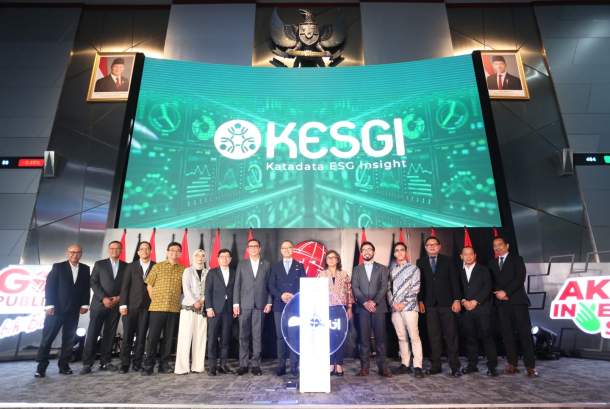
JAKARTA — The need for measurable and integrated ESG data is becoming increasingly crucial amid the push for sustainable investment and the transition to a low-carbon economy. Limitations in data and reporting standards remain the primary challenges for companies and investors in making sustainability-based decisions.
On Monday (6/4/2026), the KESGI Dashboard was launched, which compiles and analyses ESG data for listed companies on the stock market. This platform leverages expert panel assessments and artificial intelligence technology to strengthen data-based analysis and decision-making.
Co-founder and Chief Executive Officer of Katadata, Metta Dharmasaputra, stated that the development of this platform stems from the potential of the green economy as a driver of national economic growth. “Without this sector as a new driver, it seems difficult to achieve such growth targets,” said Metta.
Metta added that a 2024 survey by the Indonesia Stock Exchange (BEI) together with Mandiri Institute showed that the main challenges in implementing ESG include limitations in quantitative data, human resources, and high data collection costs.
Acting Director of BEI, Jeffrey Hendrik, conveyed that investor interest in ESG-based instruments continues to increase, in line with the development of sustainable investment products.
“BEI provides 6 ESG-based indices to encourage the creation of ESG investment products, platforms, ESG reporting guidelines, education programmes for investment actors, as well as collaboration with regulators and strategic partners like Katadata,” he said.
Referring to data from the Financial Services Authority as of February 2026, there are 72 passive mutual funds and stock-based ETFs with total managed funds reaching Rp15.83 trillion.
Strengthening the ESG ecosystem is also carried out through cooperation with several strategic partners to expand the utilisation of data and encourage the adoption of sustainability practices in various sectors.
Co-founder and Chief Content Officer of Katadata, Heri Susanto, said that KESGI was developed to simplify ESG data so that it is easier to analyse and use in decision-making.
“KESGI becomes a solution so that data can be transformed into insights, from compliance to decisions, and from fragmentation to integration,” said Heri.
KESGI uses a methodology that refers to global standards and is adapted to national regulations, with an assessment framework covering the three ESG pillars, 15 topics, and more than 100 indicators.
In the future, Katadata is also preparing the development of the ESG-50 Leader Index, which will identify companies with the best consistent ESG performance on the Indonesia Stock Exchange.
Deputy Head of Katadata Green, Jeany Hartriani, said that the implementation of ESG in Indonesia still faces challenges of complex standards and organisational readiness.
“ESG must be more than just reporting, becoming a leadership principle and underpinning company operations,” said Jeany.