
ESDM Ramadan-Idulfitri 2026 Command Post Closed, Here is the Fuel and Others Distribution Data
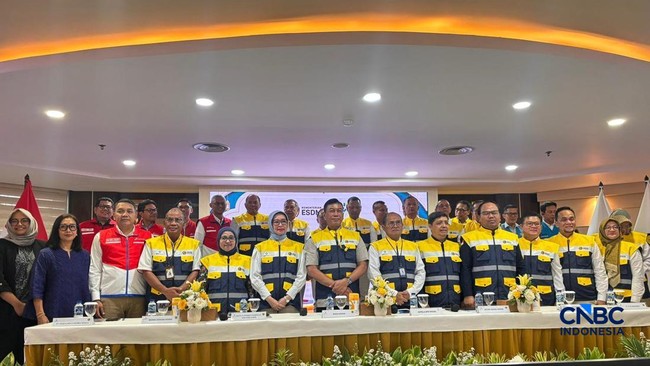
The Ministry of Energy and Mineral Resources (ESDM) officially closed the National Command Post for the ESDM Sector during Ramadan-Hari Raya Idulfitri 1447 Hijriah today, Tuesday (31/3/2026), which had been operational for 20 days from 12-31 March 2026.
RAF 2026 Command Post Chair Erika Retnowati assured that all energy supplies, from fuel, LPG, electricity, to natural gas, were in safe and controlled conditions.
Here is the detailed report on the realisation from the National ESDM Sector Command Post during Ramadan-Idulfitri 2026:
Fuel (BBM):
Erika reported that national fuel stock resilience was successfully maintained with an average above 20 days. The most significant daily consumption increase occurred in gasoline by 15% and avtur by 7.2%, while gasoil (diesel) decreased by 18% compared to normal conditions.
“Overall, the fuel stock resilience condition is reported as safe, both for gasoline, gasoil, kerosene (kerosene), and avtur types, with stock resilience successfully maintained at an average above 20 days,” Erika stated at the command post closing event at the BPH Migas Office, Jakarta, Tuesday (31/3/2026).
The peak gasoline distribution during the outbound mudik flow occurred on 19 March with a 37% increase, and the return flow on 25 March with a 20% increase. This smooth distribution was supported by the readiness of 125 fuel terminals, 7,885 petrol stations, 72 DPPU, as well as active participation from private retail business entities.
Liquefied Petroleum Gas (LPG)
LPG distribution during the command post period was also ensured to be safe with an average stock resilience of 11.6 days. The government together with Pertamina prepared 40 LPG terminals, 757 SPBE, up to 6,662 base agents operating 24 hours in areas with high demand.
“The average LPG distribution during this command post period is 34,206 metric tons or an increase of 6.5% from the normal average,” Erika explained.
The peak LPG distribution increase occurred on 16 March 2026 at 33,428 metric tons. Erika acknowledged that there were issues of supply shortages in some areas, but those obstacles were quickly handled well by the field team.
Natural Gas
Natural gas distribution to commercial, industrial, household customers, up to power plants, ran smoothly. Pertamina’s Gas Subholding (PGN) recorded supplying gas to more than 818,000 household customers and thousands of industrial commercial customers without issues.
“The average commercial gas distribution during the Idul Fitri holiday period is 735 BBTUD or down 53 BBTUD compared to the Idulfitri 2025 realisation,” Erika revealed.
Although supplies were safe, Erika noted operational challenges related to the recovery process of the Gresik-Duri gas transmission network and maintenance of supplier facilities. However, the impact on the natural gas distribution pattern in West Java and South Sumatra is now gradually returning to normal.
Electricity Supply
The electricity supply condition in the PT PLN (Persero) business area was generally in a safe status. The majority of electricity systems operated normally without experiencing power deficits during the command post period.
“Of the 24 systems continuously monitored, there are 17 systems that operated normally or never experienced alert or deficit during the command post period,” Erika clarified.
On Idulfitri Day (21 March 2026), the system’s supply capacity reached 49,718.27 Mega Watt (MW). Meanwhile, the peak load was recorded at 35,022.10 MW, resulting in the highest power reserve during the command post period of 14,695.97 MW.
Geology
During the command post period, the government also monitored national geological disasters. There were two volcanoes on Alert status, namely Merapi and Semeru, 43 landslide events, and 35 felt earthquake events, two of which were damaging in Sintang (West Kalimantan) and Sukabumi (West Java).
“All earthquake, volcano, and landslide activities did not impact the supply conditions or the smoothness of energy distribution in the fuel, LPG, natural gas, or electricity sectors,” Erika emphasised.