
ESDM: Mount Awu seismicity dominated by shallow volcanic earthquakes
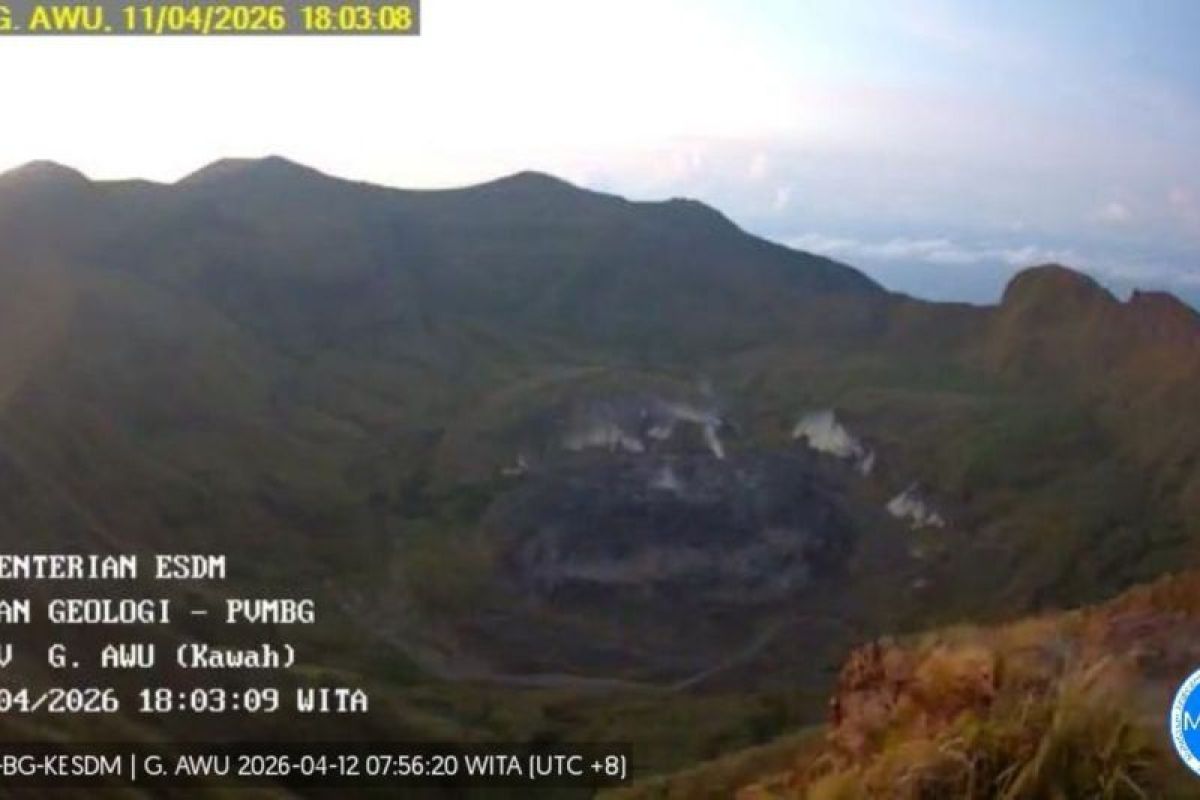
Manado (ANTARA) - The Ministry of Energy and Mineral Resources (ESDM) in its evaluation of Mount Awu’s activity in Sangihe Islands Regency, North Sulawesi, for the period 16–31 March 2026, states that the volcano’s seismicity was dominated by shallow volcanic earthquakes and distant tectonic earthquakes.
“Recorded were 281 shallow volcanic earthquakes (VB) with an average of 17 events per day, 28 deep volcanic earthquakes (VA), one local tectonic earthquake (TL), and 221 distant tectonic earthquakes (TJ),” said Acting Head of the Geological Agency, Ministry of ESDM, Lana Saria, in a report received by ANTARA in Manado on Wednesday.
The energy of the volcanic earthquakes overall, based on the RSAM (Real Time Seismic Amplitude Measurement) values from earthquake recording amplitude smoothing, showed fluctuating levels.
During that period, the RSAM graph generally still experienced fluctuations influenced by weather conditions and seismicity.
Based on the evaluation results, shallow volcanic earthquakes during that period increased, with the daily average still above normal.
The number of shallow volcanic earthquakes still above normal indicates that magmatic processes and pressure accumulation are continuing at shallow depths, causing cracking or pressure release in rocks near the surface, which needs to be watched closely.
Meanwhile, visual and instrumental observations show that magmatic activity at Mount Awu is still occurring actively.
Sudden increases in seismicity (swarm) of volcanic earthquakes or increases in ‘Low Frequency’ earthquakes still need to be monitored in the future.
Potential hazards from Mount Awu that may occur include explosive magmatic eruptions producing incandescent material ejections and/or pyroclastic flows, effusive magmatic eruptions producing lava flows, or phreatic eruptions dominated by steam, volcanic gases, or previous eruption materials.
Dome lava disruption may occur if pressure in the magmatic system experiences a significant increase.
Meanwhile, another potential hazard is volcanic gas emissions that can endanger lives if the inhaled concentration exceeds safe threshold levels.
Based on comprehensive analysis and evaluation up to 31 March 2026, Mount Awu’s activity level is at Level II (Alert), with recommendations adjusted to the latest hazard potential.
Residents are urged to comply with the recommendations, including that the public and visitors/tourists should not enter or engage in activities within a 3 km radius of the Mount Awu crater centre.
The public is encouraged to adhere to recommendations issued by the Geological Agency through the Centre for Volcanology and Geological Hazard Mitigation, not to be swayed by untrue and irresponsible news regarding Mount Awu’s activity, and to follow instructions from authorised agencies.