
ESDM Minister chairs DEN meeting to address dynamics in the Middle East
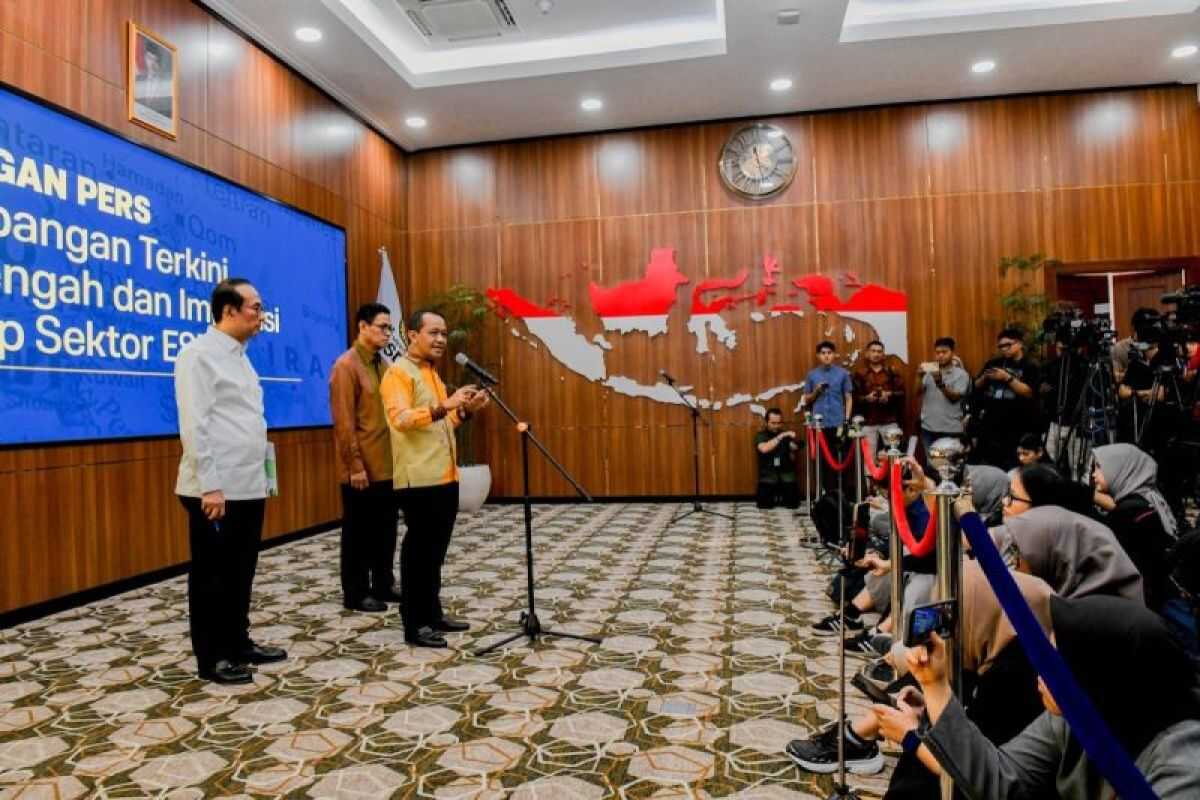
Jakarta – The Minister of Energy and Mineral Resources (ESDM), who also serves as the Acting Chair of the National Energy Council (DEN), Bahlil Lahadalia, presided over the DEN Members Session 1 of 2026 to respond to geopolitical dynamics in the Middle East region.
In a statement received in Jakarta on Wednesday, Minister Bahlil said that while observing the conditions in the Middle East, President Prabowo Subianto has asked him to ensure national energy supply availability so as not to experience shortages.
‘The President’s directive to us is that we must be very careful in calculating everything while ensuring domestic fuel oil (BBM) supply to give certainty of service to the public,’ Bahlil said as he chaired the DEN Members Session at the ESDM Ministry office in Jakarta, on Tuesday (3 March).
The conflict involving the United States and Israel with Iran in the Middle East region has the potential to impact global energy supply.
The closure of the Hormuz Strait as a result of the conflict would disrupt logistics routes of about 20 percent, equivalent to 20.1 million barrels, of global oil supply and could cause a rise in world oil prices.
The closure of the Hormuz Strait, according to Bahlil, is not merely a geopolitics issue, but also a matter of global oil supply.
Around 20.1 million barrels of oil per day pass through the strait, including supplies destined for Indonesia.
‘The crude oil supply for Indonesia’s needs that passes through Hormuz comes from Middle Eastern countries accounting for about 19 percent of national consumption or around 25.36 million barrels. The rest is drawn from Africa, Angola, the Americas, and other countries such as Brazil that do not pass through Hormuz,’ he added.
As part of mitigation strategy, the ESDM Minister continued, the government is redirecting part of crude imports from Middle Eastern countries to other suppliers with more secure supply, including supplies from the United States. This step is taken to ensure the national needs are guaranteed.
For imported BBM, Bahlil explained that Indonesia currently obtains supplies from countries outside the Middle East region, including Southeast Asia. ‘BBM imports are relatively not a problem,’ he stressed.
As for liquefied petroleum gas (LPG), whose domestic needs are still met through imports of around 7.3–7.8 million tonnes per year, the minister said the government directs most of its supply from the United States as a diversification and strengthening of national energy resilience measure.
Redirecting that commodity is one of the DEN’s main recommendations for the 1st Session of 2026.
Additionally, the meeting concluded the need to optimise the use of domestic energy resources, citing the biodiesel programme as a reference.
The DEN Members Session was attended by government figures including Industry Minister Agus Gumiwang Kartasasmita, Higher Education, Science, and Technology Minister Brian Yuliarto, National Development Planning Minister/Head of Bappenas Rachmat Pambudy, Agriculture Minister Andi Amran Sulaiman, Environment and Life/BPLH Minister Hanif Faisol Nurofiq, Transport Minister Dudy Purwagandhi, and the Kemenkeu Deputy Permanent Representative Luky Alfirman, who is Director General of Budget at Kemenkeu.
Additionally, eight DEN Members from stakeholder groups attended.
Referring to Presidential Regulation Number 26 of 2008, the DEN holds plenary sessions at least twice a year, and member sessions chaired by the acting chairman at least once every two months or as needed.
Decisions and recommendations from the DEN Members Session 1 of 2026 are expected to serve as operational guidelines for the ministries and related agencies to maintain stability of national energy supply amid global uncertainty.