
ESDM Expert: Accelerating Solar Power Plants as the Backbone of Indonesia's Energy Transition
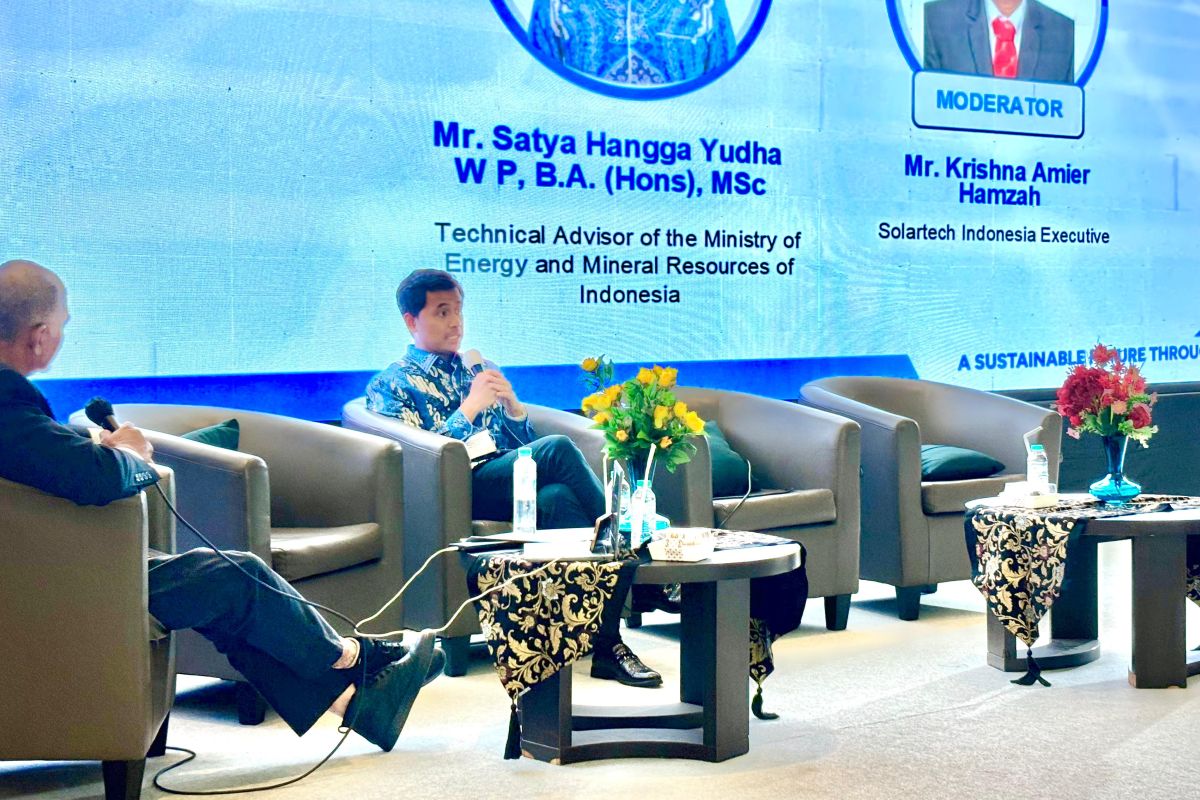
Jakarta (ANTARA) - Satya Hangga Yudha Widya Putra, Expert Advisor to the Minister of Energy and Mineral Resources (ESDM) for the Commercialisation and Transportation of Oil and Natural Gas Sector, stated that accelerating the development of solar power plants (PLTS) is the backbone of Indonesia’s energy transition.
According to the ESDM Minister’s Expert Advisor, in his statement in Jakarta on Thursday, President Prabowo Subianto has set a target to add 100 GW of PLTS capacity.
Based on technical calculations, building 1 MW of PLTS requires around $1 million, meaning that achieving the 100 GW target will require an investment of $100 billion.
Hangga emphasised that the government cannot shoulder such a massive financial burden alone.
“Cross-sectoral synergy is needed between ministries, PLN, Danantara, and private parties both domestically and from abroad to attract investors. We need to pursue technology and investment simultaneously so that this ambitious target can be accommodated in the RUPTL,” said Hangga while serving as a speaker at the “Solar PV & Energy Storage Forum 2026: Innovative Financing Models for Solar PV in Indonesia” event in Jakarta on Wednesday (22/4).
The government is also promoting an inclusive model in energy management similar to policies in the mining sector in 2025.
By granting business permits to regional government-owned enterprises (BUMD), MSMEs, cooperatives, religious organisations, and universities, it is hoped that a multiplier effect will be created for the regional economy.
This concept has been trialled in the optimisation of community oil wells managed by cooperatives to increase national lifting, and now the same pattern will be applied to succeed the national PLTS programme.
Currently, the Ministry of ESDM is drafting a presidential regulation (perpres) as a strong legal framework for the implementation of the 100 GW PLTS.
This step is being taken to ensure the target aligns with the National Energy Policy (KEN) as outlined in Government Regulation (PP) Number 40 of 2025.
Hangga added that Indonesia’s main challenge as an archipelagic nation lies in distribution and transmission, with abundant wind potential in Sulawesi, gas in Kalimantan, Aceh, and Papua, which requires transportation and LNG regasification to be economical, while solar energy is available evenly across the country.
To connect these scattered potentials, he continued, building infrastructure such as subsea cables is a future priority.
“With a strong commitment to the Paris Agreement and NZE (net zero emissions), the government is optimistic that through the integration of regulations, funding innovation, and appropriate technology, Indonesia can optimally utilise its natural resource wealth to achieve independent and sustainable energy sovereignty,” said Hangga.