
ESDM: Conversion to Solar Power Plants Could Save Up to Rp73.9 Trillion per Year
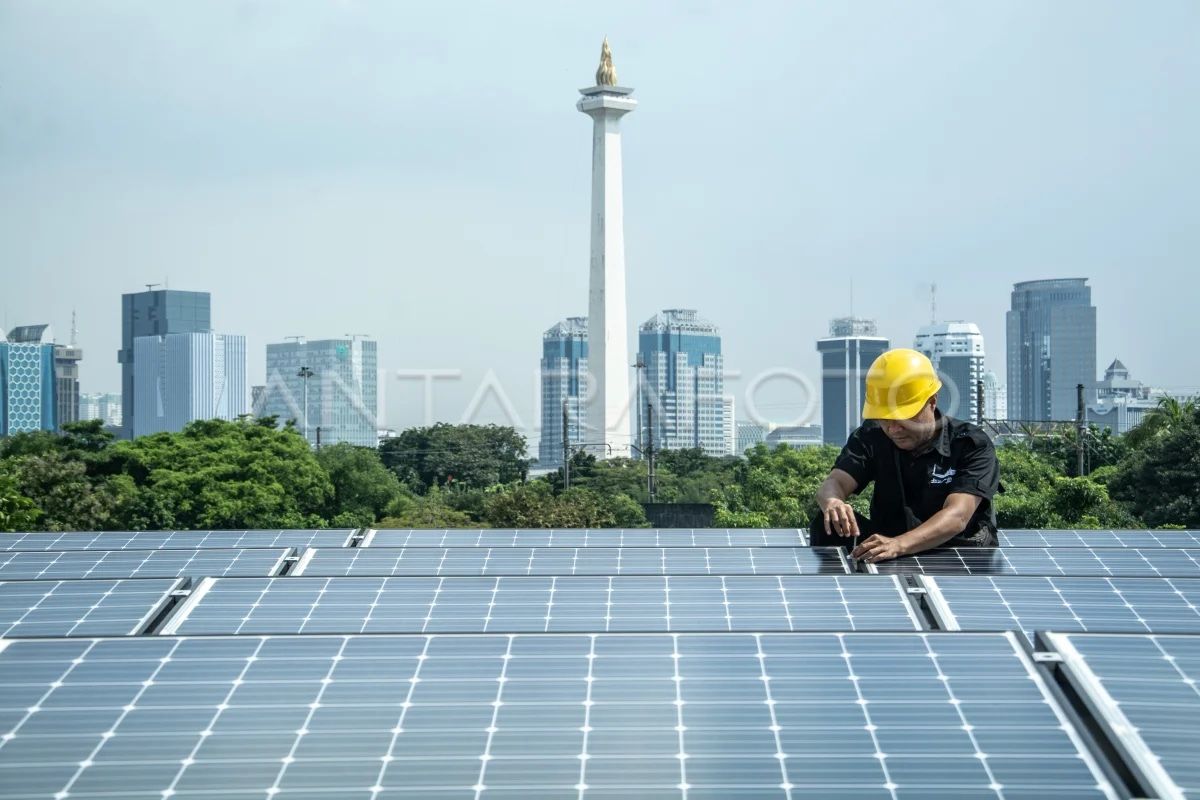
Jakarta — The Ministry of Energy and Mineral Resources (ESDM) has stated that converting fossil-fuel-based power plants, such as gas and diesel-fired plants, to solar power plants (PLTS) has the potential to reduce electricity generation costs by up to Rp73.9 trillion per year.
Senior Strategic Planning Expert of ESDM, Jisman P. Hutajulu, explained that the efficiency arises from a comparison of generation costs between PLTS integrated with a battery energy storage system (BESS) and diesel- and gas-fired power plants that are still in operation, particularly in certain regions.
said, If the 100 GW PLTS programme is completed, it would replace the diesel-fired PLTD plants, which are very inefficient, in both the eastern region and Java–Bali, which is also quite significant,” Jisman said at the HIPMI Power Development Forum 2026 in Jakarta on Wednesday.
The Government aims to deploy PLTS with a total capacity of 100 GW within 2026–2028 as part of the national energy transition strategy.
Jisman noted that realising the target would require investment of around USD 71.3 billion or equivalent to Rp1,140 trillion.
On the other hand, PLTS development also has the potential to deliver broad economic impacts.
The project is estimated to absorb up to 2.8 million construction sector jobs and 1.5 million to 3.1 million jobs in the manufacturing sector.
Moreover, the development of 100 GW PLTS could also reduce energy imports with a substitution value ranging from USD 14.4 billion to USD 28.9 billion, and contribute up to USD 26.6 billion to gross domestic product (GDP).
Nevertheless, Jisman acknowledged that large-scale PLTS development still faces challenges, particularly in terms of transmission infrastructure.
The Government expects the construction of a supergrid transmission network to reach 48,000 kilometres to ensure optimal distribution of electricity from renewable energy.
He explained that load centres are currently concentrated on the island of Java, while renewable energy potential is largely located outside Java.
In PLN’s 2025–2034 Electricity Supply Business Plan (RUPTL), the government targets an additional capacity of 69.5 GW.
Of this total, 42.6 GW or 61 percent comes from New and Renewable Energy, supported by storage systems of 10.3 GW.