
Environment Minister Reveals Indonesia's National Waste Emergency
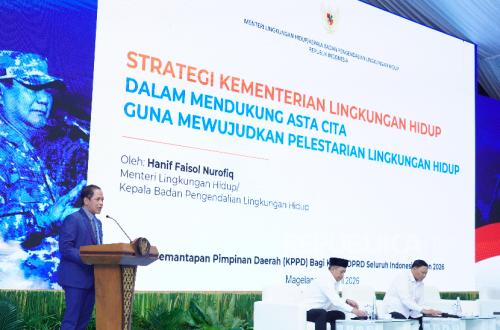
Indonesia is currently facing a national waste emergency. This was stated by the Minister of Environment (LH) of the Republic of Indonesia, Hanif Faisol Nurofiq, during a panel discussion session with participants of the Local Leadership Enhancement Course (KPPD) for Chairs of Regional People’s Representative Councils (DPRD) across Indonesia at the Military Academy (Akmil) in Magelang City on Saturday (18/4/2026).
Hanif explained that Indonesia produces 143,000 tonnes of waste per day. This figure is based on a conversion rate of 0.5 kg per person per day with a population of 288.3 million people. Of the 43,731 waste management facilities across Indonesia, he continued, only 33,249 units are functioning optimally, so only 37,000 tonnes of waste are managed per day, or about 26%.
This situation is exacerbated by the fact that 324 out of 480, or 69%, of the final disposal sites (TPA) still in operation use the open dumping system. Such open waste disposal practices have been proven to pollute the surrounding soil, water, and air.
“This then causes an extraordinary emergency in almost all districts and cities without exception. Our negligence over nearly 13 years since the enactment of Law No. 18 of 2008 on Waste Management, and its impact today, means everyone is directly facing waste cases,” said Hanif.
Therefore, he continued, the Ministry of Environment has set two urgent steps for 2026: ending all open dumping practices at the 324 TPA across all districts/cities without exception, and only allowing inorganic waste or residue to enter TPA starting from August 2026. All waste must be handled upstream through waste sorting and TPS3R facilities.
Hanif emphasised that the root problem is not technology or methodology, but managerial issues including weak governance, low public awareness, inconsistent law enforcement, and limited funding. Nevertheless, not all regions face these problems.
According to Hanif, East Java Province has recorded the highest national waste management achievement, reaching 52.5% with 13 districts/cities earning the ‘Towards a Clean City’ predicate. Therefore, the role of provincial and district/city DPRDs is considered crucial, both in approving budgets and supervising implementation in the field.