
Entering population ageing phase, BPS urges Bali to prepare facilities
Denpasar, Bali (ANTARA) - The Central Statistics Agency (BPS) has urged the Bali Regional Government to prepare support facilities, as the province’s population has entered the ageing phase.
“Bali’s population has already entered the elderly age group and naturally needs attention from the government regarding the facilities required,” said the Head of BPS Bali, Agus Gede Hendrayana Hermawan, in Denpasar, Bali, on Wednesday.
He explained that this data comes from the results of the 2025 Inter-Census Population Survey (Supas), which shows an increasing dependency ratio, with the proportion of Bali’s elderly population rising from 8.42% to 9.89%.
Meanwhile, the youth and working-age populations have declined over the past five years.
“If the ageing population is interpreted positively, it means the health level is improving, as people are living longer, but what needs to be anticipated is whether we have provided various facilities for them, as their facilities will certainly be different,” said Agus Gede.
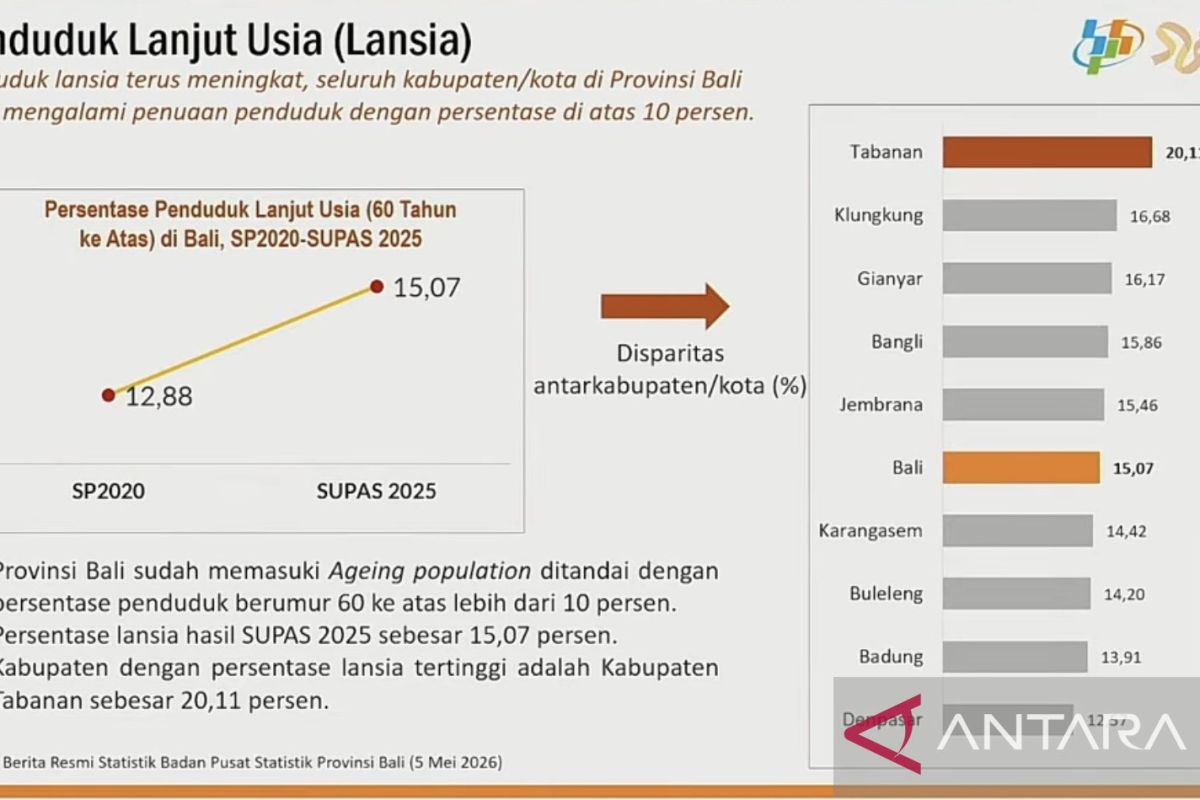
According to him, for the elderly population, the percentage of elderly residents has increased from 12.88% in the 2020 Population Census (SP) to 15.07% in the 2025 Supas.
This population ageing phase, exceeding 10%, has occurred uniformly across all regencies and cities in Bali, allowing interventions to be implemented throughout the region.
“Tabanan has the highest percentage of elderly population at 20.11%, followed by Klungkung at 16.68%, Gianyar at 16.17%, Bangli at 15.86%, and Jembrana at 15.46%, while those below the provincial average are Karangasem at 14.42%, Buleleng at 14.20%, Badung at 13.91%, and Denpasar at 12.57%,” said Agus Gede.
The increase in the elderly population is also in line with the decline in Bali’s total fertility rate (TFR), or total births per woman, in the 2025 Supas.
From the 2020 census, the birth trend per woman aged 15-49 years in Bali was 2.04, while in 2025 it is 2.02, with the lowest births in Tabanan and the highest in Karangasem.
BPS Bali views that if this continues, it is reasonable for the Bali Provincial Government to encourage population births through incentives for the third and fourth children.
Moreover, the 2025 Supas captures that Bali’s population growth rate has slowed over the past five years.
If the 2010-2020 population growth was 1.01% per year, BPS Bali data shows that from 2020-2025, Bali’s population growth is 0.69% and has the potential to decline further until 2035.