
Energy Waqf at Mosques: A Manifestation of Faith in Safeguarding Environmental Sustainability
Climate crisis is no longer a future threat but a tangible problem already being felt in Indonesia today. Phenomena such as flooding, drought, and rising air temperatures demonstrate the undeniable impacts of climate change that can no longer be dismissed as distant global concerns.
One effort to address this crisis is the transition from fossil fuels to renewable energy. As a country with one of the world’s largest Muslim populations, Indonesia has tremendous potential to lead this movement. With more than 230 million Muslims, Indonesia possesses a strong moral and social foundation for implementing religion-based solutions to environmental challenges, particularly through the concept of Ecotheology championed by the Ministry of Religious Affairs.
Prof Dr Waryono Abdul Ghafur, Director of Zakat and Waqf Empowerment at the Ministry of Religious Affairs of the Republic of Indonesia, stated that implementation of Ecotheology has begun, integrating religious concepts into environmental protection efforts. He explained how the ministry is directing concrete steps to realise energy transition programmes in mosques through strong ecosystem support, clear regulation, and collaboration with various stakeholders.
In recent years, the Ministry of Religious Affairs has introduced the concept of Ecotheology, combining environmental awareness with sustainable natural resource utilisation. This initiative began with a programme providing solar panel installation assistance (PLTS) to several Islamic boarding schools, representing a step towards introducing renewable energy solutions.
“Since I’ve been in the Directorate, we have provided solar panel installation assistance to several pesantren. What we now call Ecotheology by the Minister of Religious Affairs is the beginning of our efforts to integrate environmental awareness with religious life,” he told Republika on Friday (27 February 2026).
However, the initiative does not stop there. The Ministry of Religious Affairs is committed to expanding this programme so that more mosques throughout Indonesia can implement renewable energy, whilst also supporting the socio-economic sustainability of the Muslim community.
He conveyed that the application of Ecotheology aims to encourage the Muslim community to see the relationship between religion and the environment more holistically. This commitment is not merely rhetoric; the ministry has begun formulating programmes that prioritise not only religious ritual aspects but also concern for natural sustainability.
“We also have programmes utilising zakat and waqf, including how to revitalise dormant waqf assets,” he said.
Indonesia, he noted, possesses significant potential in terms of religious social funds such as Zakat, Infak, Sedekah, and Waqf (ZISWAF) managed by the National Zakat Collection Agency (BAZNAS), Zakat Collection Institutions (LAZ), and the Indonesian Waqf Board (BWI). This potential grows significantly each year and represents a substantial resource for supporting various sustainability programmes, including mosque-based renewable energy transitions.
Therefore, Waryono is encouraging the transformation of religious social fund utilisation to make them productive and sustainable. In his view, “Alhamdulillah, we are not only cooperating with the nearest zakat and waqf ecosystem, but even organisations concerned with the environment, such as WWF and UNDP, are also collaborating with us on how we can jointly preserve the environment through religious social funds,” he said.
“The reference roadmap is the National Medium-Term Development Plan (RPJMN) and Regional Medium-Term Development Plans (RPJMD), so it is not merely charity. It is also about community empowerment,” said Waryono.
Moreover, Waryono emphasised the importance of optimising waqf assets that have previously remained underutilised productively. Waqf land assets can be used for various activities, such as planting productive trees that support carbon absorption, as well as supporting renewable energy infrastructure such as solar power plants (PLTS).
He also revealed that they have set long-term targets for energy transition in mosques through 2029, focusing on ten provinces with high poverty rates. This programme aligns with the RPJMN roadmap and is expected to create significant impacts on the economic and social strengthening of the Muslim community. Provinces such as Yogyakarta, Banten, and DKI Jakarta are included in the priority list for renewable energy development in mosques.
“That’s correct—the Ministry of Religious Affairs always strives maximally in translating the Ecotheology vision,” he said. “We are not just talking; we are acting.”
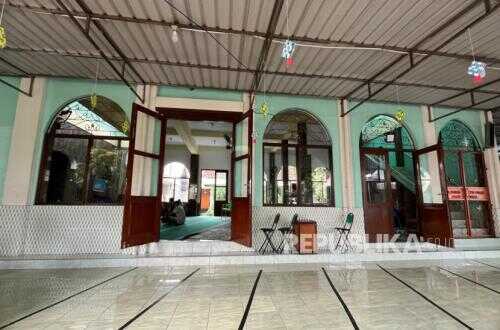
His hope is that mosque administrators and boards will understand the importance of mosques’ role in preserving the natural environment and contributing to environmental conservation. The Ministry of Religious Affairs is calling for every mosque to become a “green mosque” that supports Ecotheology principles.
“If I may convey a message to mosque boards and administrators, that mosques can also contribute to environmental preservation and nature conservation. Because of this, there must also be awareness that there should be green mosques. Religion is not only about worship; it is also about protecting nature,” he said.
Waqf as a Path to Sustainable Development
The Indonesian Waqf Board (BWI) plays an important role in supporting mosque-based energy transitions through productive waqf management. Speaking separately, Deputy Chairman of BWI, Dr H Tatang Astarudin, explained that waqf is not merely for social or religious activities but can also serve as an instrument for broader sustainable development, including the utilisation of renewable energy such as solar power.
According to him, this initiative aligns with the vision of waqf, which is always oriented towards public welfare and environmental preservation, even long before the concept of sustainable development or the Sustainable Development Goals (SDGs) emerged.