
Energy-Saving Initiative: Governor Ahmad Luthfi Commutes to Work by Bicycle
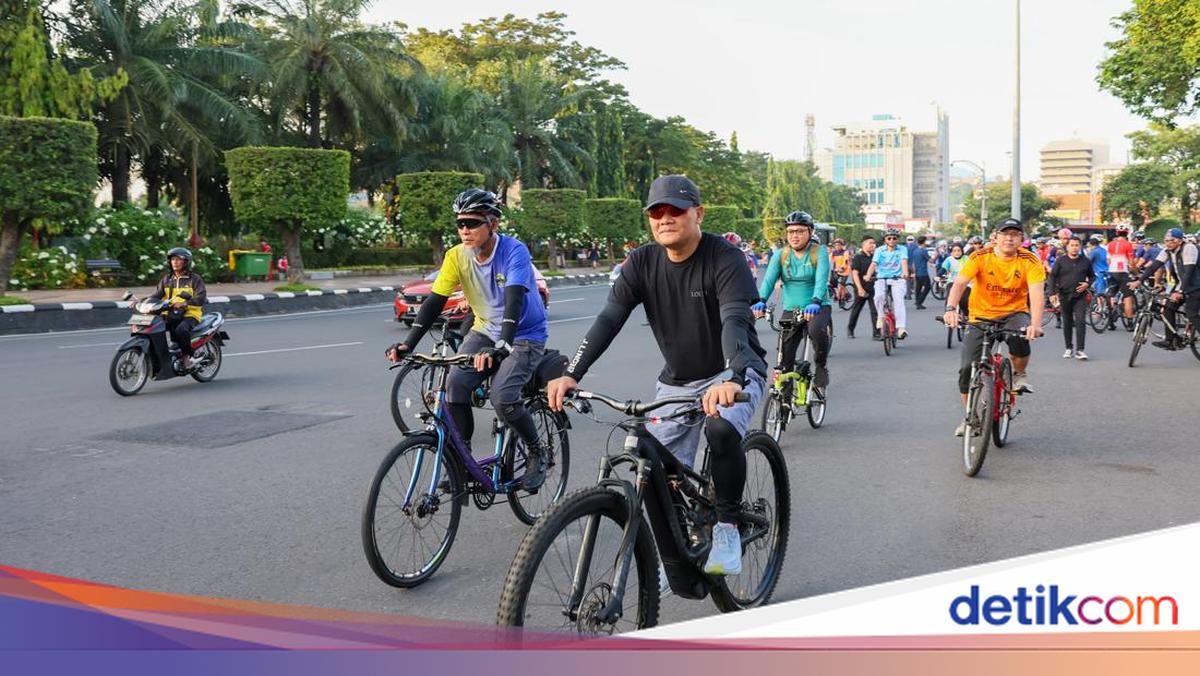
From their respective homes, they gathered in front of the Baiturrahman Grand Mosque in Semarang City before continuing their ride through Simpang Lima-Jalan Gajahmada-Jalan Imam Bonjol-Jalan Piere Tendean-Jalan Pemuda, Tugu Muda-Jalan Pandanaran-Simpang Lima-Jalan Pahlawan, finishing at the Central Java Governor’s Office.
Commute to work by bicycle (bike to work) aims to set an example for the civil servants (ASN) under his command and the public to save energy.
Luthfi stated that efforts to save energy must become a culture in Central Java society. Many methods can be employed, such as cycling to the office, using public transport, and others.
“I see that our ASN include some who cycle, some who use electric vehicles, up to those who take angkot. This should not be just because of a circular, but make it a culture so that it becomes enjoyable and does not feel burdensome,” said Luthfi, in a written statement on Thursday (9/4/2026).
According to him, the bike to work movement is not merely a campaign, but an effort to transform work culture to save energy while exercising.
This transformation is emphasised in the Circular from the Minister of Home Affairs Number 800.1.5/3349/SJ on the Transformation of Civil Servant Work Culture and the Central Java Governor’s Circular Number B/000.8.3/3/2026 on the Transformation of Civil Servant Work Culture in the Central Java Provincial Government Environment.
In the circular issued by the Central Java Provincial Government, among other things, it includes the implementation of work from home (WFH) for some ASN every Friday, limiting or reducing official travel, prioritising meetings, technical guidance, seminars, conferences, and others to be conducted in hybrid mode (offline and online) by maximising the use of information and communication technology.
In the circular, ASN also need to limit and reduce the use of official vehicles by a maximum of 50%, increase the use of electric vehicles, public transport, bicycles, and other non-fossil fuel-based transport.
In addition, the transformation of ASN work culture is also carried out through the use of electricity in work rooms turned on from 06.30-15.30 WIB according to real needs, and outside rooms/open spaces in a limited manner from 17.30-05.30 WIB; the use of AC applied at an efficient temperature of 24-26ºC according to needs; lights/room coolers (AC) that are left for 2 hours or more turned off according to needs; the use of clean water controlled according to real needs in the field, and initiating the use of new renewable energy (EBT), such as solar panels in the office environment, and others.
ASN can also walk, prioritised for employees with a distance between home and office of less than or equal to approximately 1.5 kilometres; use non-fuel transport such as bicycles and electric bicycles, prioritised for ASN with a distance between home and office of less than 10 kilometres and relatively flat terrain; use public transport for those feasible in terms of accessibility, distance, and travel time, as well as availability of transport facilities; and use shared vehicles (carpooling or ride-sharing) for several employees according to vehicle capacity.
“Energy saving is not just a framework of orders, but we must cultivate energy saving by exercising, work from home, then turning off lights (if not used), and seeking renewable energy,” explained Luthfi.
Regarding new renewable energy, the Central Java Provincial Government is also promoting independent energy villages in its region. The Regional Owned Enterprise (BUMD) in the energy sector, namely PT Jateng Petro Energi (JPEN), has also used renewable energy as a household energy source through Compressed Natural Gas (CNG) cylinder products.
In addition, the Central Java Provincial Government provides tax incentives to companies that have used new renewable energy. All of this is done to support energy saving and prepare for green industries in Central Java.