
Energy Crisis and One-Day-a-Week WFH: Business Owners Offer These Suggestions
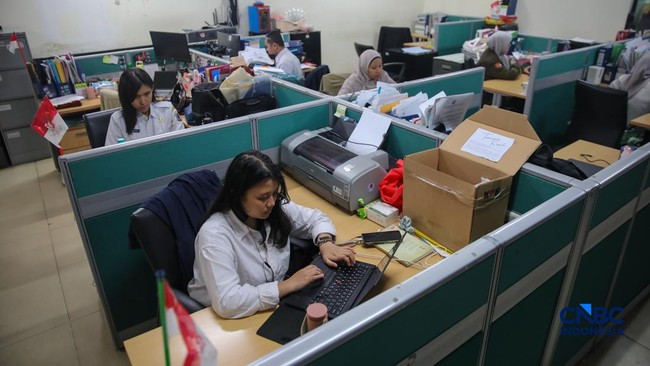
The government’s one-day-a-week work-from-home (WFH) policy, as a measure to anticipate the ripple effects of the Middle East conflict triggering global energy price fluctuations, has received a response from business circles.
The Indonesian Employers’ Association (Apindo) assesses that this step must be balanced with measured policies to avoid disrupting business activities, especially amid global pressures such as rising energy prices.
Apindo’s Head of Labour Affairs, Bob Azam, stated that the government needs to prepare concrete steps, both short-term and long-term, to maintain economic stability amid potential prolonged global disruptions.
“Regarding recommendations to the government in facing potential prolonged disruptions and global/domestic inflationary pressures, Apindo views that the government needs to take strategic steps both in the short and long term,” Bob told CNBC Indonesia on Thursday (2/4/2026).
In the short term, the business world emphasises the importance of maintaining macroeconomic stability and containing the impact of global volatility. Some proposed steps include, first, maintaining stability through controlling energy prices, exchange rates, and smooth supply chain logistics.
Second, limiting the transmission of global pressures with adaptive and measured sector-based policies, as well as clear communication to business actors. Third, strengthening domestic consumption and providing targeted stimulus for labour-intensive industries.
Fourth, maintaining business competitiveness through liquidity support, reducing high costs, deregulation, and eliminating business barriers.
Meanwhile, in the medium to long term, according to Bob, structural strategies are needed to increase economic resilience. These steps include, first, accelerating national energy resilience through strengthening alternative energy.
Second, ensuring the energy mix aligns with infrastructure readiness and industrial competitiveness. Third, strengthening the domestic upstream sector to reduce dependence on imported raw materials. Fourth, gradually and measured reform of energy subsidies, while maintaining public purchasing power and business logistics costs.
On the other hand, regarding the WFH policy, Bob said that the business world in principle understands the government’s objectives. This policy is seen as part of anticipating global conditions, particularly potential rises in energy prices and fuel consumption.
“Regarding the plan to encourage WFH one day per week, the business world in principle understands that this policy is part of the government’s efforts to anticipate global conditions, especially related to potential increases in energy prices and their impact on fuel consumption,” he said.
He stated that this step can also be part of efforts to build vigilance in facing geopolitical dynamics.
“From the business world’s perspective, this step can be understood as part of efforts to build a sense of crisis while increasing preparedness in facing the currently quite volatile geopolitical dynamics,” he explained.
However, WFH implementation is assessed as not being able to be generalised for all sectors. For back-office work and non-essential activities, this policy is relatively non-disruptive to productivity. Conversely, real sectors such as manufacturing, logistics, trade, and the food and beverage industry are seen to have limitations in implementing WFH.
“In this context, exceptions for public services and strategic sectors are the right step to ensure economic activities continue to run,” he said.
For this reason, Bob views that the government is correct in positioning the WFH policy for private sector employees as a selective and measured encouragement, with adaptation space at the company level according to each operational needs.
“What is also important is ensuring its implementation does not cause disruptions to supply chains, goods distribution, or services to the public. With an adaptive approach, this policy can still run without sacrificing productivity and business continuity,” Bob said.
Previously, the government officially implemented the one-day-a-week WFH policy for civil servants (ASN), namely every Friday starting 1 April 2026. Coordinating Minister for the Economy Airlangga Hartarto said that this policy is part of the national work culture transformation that prioritises efficiency and modernisation of the work system.
“Implementation of WFH for ASN in central and regional areas one working day every Friday,” Airlangga said during an online press conference on Tuesday evening (31/3/2026).
Meanwhile, on Wednesday (1/4/2026), Minister of Manpower Yassierli stipulated that private sector workers, SOEs, and regional SOEs also follow the one-day-a-week WFH policy, but it is in the form of encouragement and adjusted to each company’s conditions.
“WFH implementation does not reduce annual leave. Workers or labourers carrying out WFH still carry out their work according to their duties and obligations,” Yassierli said during a press conference at his office in Jakarta.
Yassierli also emphasised that several sectors are exempted from this policy, such as health, energy, industry, transportation, and food and beverage sectors, to maintain service continuity and operations.