
Empowering Women as Capital for Achieving National Progress
“Peace is not merely the absence of war. It is a virtue,” wrote the philosopher Baruch Spinoza.
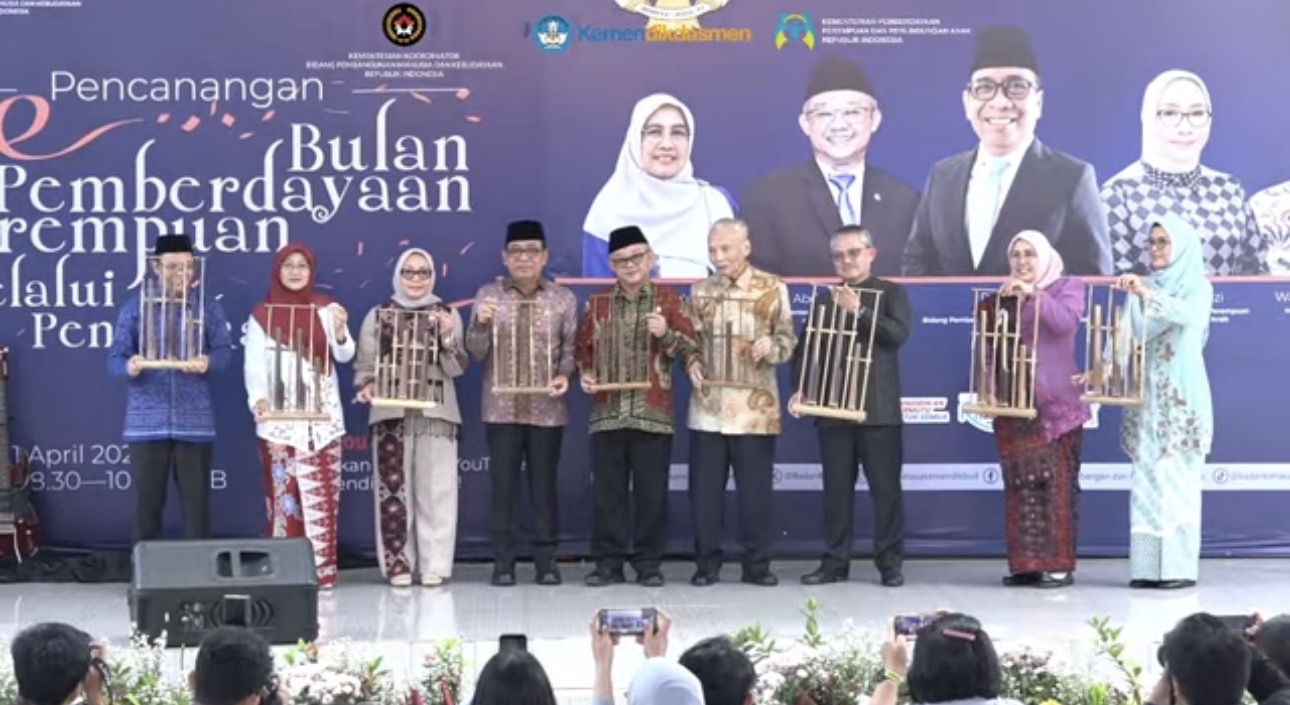
The government, through the Ministry of Basic and Secondary Education, has launched the Month of Women’s Empowerment through Education. This initiative involves the Ministry of Women’s Empowerment and Child Protection (Ministry of PPPA) and the Coordinating Ministry for Human Development and Culture (Kemenko PMK).
Minister of Basic and Secondary Education, Abdul Mu’ti, stated that empowering women is a capital for achieving national progress.
“We are committed to providing greater opportunities for women to access education and develop their potential,” he said at the launch of the Month of Women’s Empowerment through Education at the Office of the Language Development and Cultivation Agency (Badan Bahasa), Jakarta, on Wednesday (1/4).
Furthermore, Abdul Mu’ti acknowledged that realising this is not easy due to various challenges encountered in the field, most of which relate to theological obstacles.
“For example, some believe that women are created from man’s rib. I somewhat critique this view because it implies women’s subordination. There are also cultural barriers where women are seen as second-class gender or in certain communities, women are thought to only handle cooking. This subordination still occurs in certain contexts in our society,” said Abdul Mu’ti.
“There are also psychological myths claiming that women’s intelligence is half that of men. Hence the myth that women are suited for fields like secretaries, treasurers, consumption sections, and the like. But if there’s a head or chair, it’s usually men. Security sections are for men. This stigma must not continue,” he added.
According to Abdul Mu’ti, the fact is that women have many strengths, particularly in memory power that is far stronger than men’s.
“Women are stronger in memory related to details, while men are more general. That’s why men often forget what was said because there’s a psychological basis for it. Therefore, jobs like nursing are mostly done by women, midwives too, but obstetricians are mostly men. Thus, we must demystify this because women actually have good abilities,” he explained.
To that end, he emphasised that various myths about women must be eradicated so that women can have broader spaces for actualisation and develop their potential according to their talents and interests, as guaranteed by the constitution.
“Therefore, we are committed to providing opportunities for girls in Indonesia to emerge as Indonesia’s great generation with all their potential,” Abdul Mu’ti asserted firmly.
At the same venue, Minister of PPPA, Arifah Fauzi, said that data from the Central Statistics Agency (BPS) for 2025 shows the position of Indonesian women at 49.85 percent and children at 29.15 percent. This means women and children have a strategic role in realising Golden Indonesia 2045.
“However, we must not turn a blind eye to the many challenges faced by women and children. Especially deviations in education, economic limitations, and high vulnerability to violence, which indicate that our development needs to be strengthened with a gender justice perspective,” said Arifah.
In the education sector, it is evident that many girls still drop out of school due to child marriage, economic constraints, and social norms that prioritise boys’ education.
“However, currently in some universities, women’s involvement is extraordinary. At UI (University of Indonesia), new female students exceed 50 percent. At UIN (State Islamic University), new female students also exceed 50 percent,” she stated.
Therefore, Arifah understands that education is the main foundation for women’s empowerment. Education is not just about gaining knowledge, but building self-confidence, expanding life choices, and improving decision-making quality at individual, family, and social levels.
The government has established gender mainstreaming as a national strategy in development. Gender mainstreaming ensures that women and men have equal access, participation, control, and benefits in the development process.
In the education realm, the implementation of gender mainstreaming is carried out through several measures, including strengthening gender-responsive policies and planning, transforming curricula and teaching materials to create safe and inclusive educational environments, enhancing the capacity of educators and education personnel, and expanding access and participation for women, especially in STEM fields.
“However, we must also acknowledge various challenges in implementation, such as limited understanding of gender, human resource capacity, and suboptimal cross-sectoral synergy. Therefore, education and protection are two inseparable aspects. A quality educational environment must also be a safe environment for children. The principle is clear: no child should be left behind, and no child should feel unsafe in the school environment,” said Arifah.
On the other hand, the Coordinating Minister for Human Development and Culture, Pratikno, emphasised that empowering women is key to creating a great generation towards Indonesia’s future.
“For us who handle education, if we empower