
Emerging Phenomenon: Many Indonesian Companies Not Hiring New Workers, What's Going On?
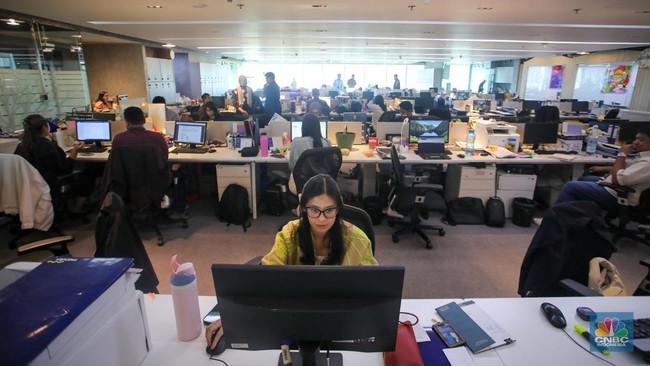
Jakarta, CNBC Indonesia - Business owners have revealed that many companies are not planning to open job vacancies for new workers, a situation that has become a serious concern for the government.
Apindo’s Head of Labour Affairs, Bob Azam, stated that in a survey conducted by APINDO, 67% of companies will not recruit new workers.
“Currently, 67% of companies have no intention of recruiting new workers. This is something we believe needs attention,” Bob said during his presentation at a hearing with Commission IX of the House of Representatives (DPR RI) regarding the Employment Bill (RUU Ketenagakerjaan), on Tuesday (14/4/2026).
Not only that, 50% of companies in Indonesia have chosen not to expand over the next five years, due to unfeasible global conditions.
“Our APINDO survey results also show that currently, 50% of companies have no plans for expansion in the next five years. This is also a concern for us,” he continued.
Bob highlighted the frequent changes in labour regulations, which are seen as disrupting business certainty. In the last 10 years alone, there have been five changes to labour regulations.
However, businesses must make long-term contracts. According to him, the longer the contracts they make, the more job certainty it provides for workers.
“As business owners, we face great difficulties if the regulations change every one or two years. Meanwhile, we in business must make contracts; the longer the contracts, the better, as it allows us to guarantee employment for our workers. But if the regulations change, we struggle to calculate the actual cost of labour, say for the next three, four, or five years. This is also very distressing for the business world,” he explained.
His side hopes that the new Employment Bill will produce regulations capable of addressing various fundamental issues in the labour sector. The new rules are also expected to follow up on the mandates of the Constitutional Court (MK) decision.
“We hope that the law formed will not only cover employment issues but also solve labour problems,” he clarified.