
Elongation of the Crescent in Islamic Astronomy: Definition and Role in the Isbat Session
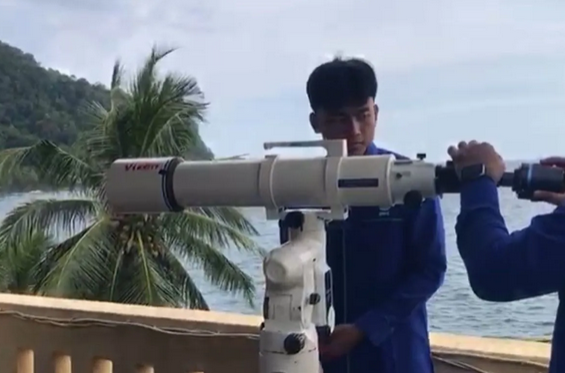
In determining the start of the Hijriah month, the elongation of the crescent plays a vital role as a physical parameter for the visibility of the new moon. Without an adequate elongation angle, the crescent optically cannot reflect enough light to penetrate the twilight glow of the setting sun (syafaq).
Elongation is the angular distance between the Moon and the Sun as seen from Earth. In the context of rukyatul hilal (crescent sighting), elongation determines the thickness of the moon’s crescent. The larger the elongation angle, the thicker the visible crescent, and the greater the chance of it being observed by sighters.
Based on the agreement of the Ministers of Religious Affairs from Brunei, Indonesia, Malaysia, and Singapore (MABIMS), the minimum criteria for the crescent to be declared as marking the new month are an elongation of 6.4 degrees and a height of 3 degrees.
There are two methods for calculating the elongation angle, which often become subjects of discussion among falak (Islamic astronomy) experts.
The choice of 6.4 degrees is not arbitrary. This figure refers to the Danjon Limit, where the moon’s crescent physically begins to form and can reflect light. If the elongation is below this number, even if the moon is above the horizon (positive height), scientifically, the crescent is considered not yet “existent” for human eyesight (imkanur rukyat).
This figure is based on empirical data from global observations showing that crescents with elongation below 6.4 degrees are too thin, and their light is overwhelmed by the background light of the evening sky.
Height is the vertical distance of the crescent from the horizon line (cakrawala), while elongation is the direct angular distance between the Moon and the Sun. Both must be met for the crescent to be considered visible.
It is very difficult. If the height is too low (below 3 degrees), atmospheric interference and the still-bright syafaq light will obscure the appearance of even a thick crescent.
Understanding crescent elongation helps us realise that the determination of the Hijriah month start in Indonesia is done with a highly precise scientific approach. The combination of hisab data (calculations) and rukyat verification (observations) ensures that Muslim worship begins at the appropriate time both astronomically and in accordance with sharia.
The Ministry of Religious Affairs in Maluku reported that the 1 Syawal 1447 H crescent failed to be seen in the Land of Wakasihu because its position was still below 2 degrees.
The Ministry of Religious Affairs reported that the position of the 1 Syawal 1447 H crescent across Indonesia did not meet MABIMS criteria. See the full astronomical analysis.
See the latest 2026 MABIMS criteria for determining Ramadan and Eid al-Fitr. Understand the parameters of 3-degree crescent height and 6.4-degree elongation in full.
The Ministry of Religious Affairs set the start of fasting for 1 Ramadan 2026 on Thursday, 19 February. The Isbat session decision was based on MABIMS criteria and crescent results.
See the reasons why MABIMS criteria are the main reference in the 2026 Isbat session for determining the start of Ramadan 1447 H scientifically and legally.
Why must there be an Isbat session to determine Eid? See the full explanation from the perspectives of state law, religious sharia, and astronomical science.
If viewed from the illustration of the crescent’s position on the western horizon, all provincial capitals in Indonesia are below MABIMS criteria.
For the first time, IKN became the location for rukyatul hilal to determine 1 Ramadan 1447 H. The BMKG East Kalimantan stated that the crescent was not visible because it was still below the horizon.
The crescent monitoring team from the BMKG Class III Geophysics Station in Malang reported that the crescent phenomenon was not visible in the Malang area, East Java, in the afternoon on Tuesday (17/2).
Observation locations are selected selectively, considering the openness of the western horizon, minimal light pollution, good atmospheric conditions, as well as accessibility and security of the location.